As an Amazon Associate, we earn from qualifying purchases. Some links on this site are affiliate links at no extra cost to you. Our recommendations are based on thorough research and editorial judgment.

Why Some Batteries Get Warm During Charging

Batteries warm during charging primarily due to internal resistance, which generates heat following the formula P = I²R; for example, a 77 milliohm resistance at 17 amps produces about 22 watts of heat, elevating temperature by several degrees Celsius. Electrochemical reactions and reduced charging efficiency near full capacity also increase heat, especially above 40°C, where risks rise substantially. Chargers with improper voltage or current settings exacerbate this effect. Understanding these factors clarifies how heat impacts battery performance and safety.
Key Takeaways
- Battery heating occurs mainly due to internal resistance causing Joule heating, where heat is proportional to the square of the charging current.
- Electrochemical reactions inside batteries generate extra heat, especially at high charge currents and near full capacity.
- Aging or damaged batteries have higher internal resistance, leading to excessive heat during charging.
- High charging currents and voltages amplify heat production by increasing current flow and internal resistance effects.
- Proper charger selection and temperature monitoring prevent overheating and ensure safe, efficient battery charging.
Understanding Battery Heating Mechanisms
A variety of intrinsic factors contribute to the heating observed in batteries during charging, primarily stemming from internal resistance, which varies according to the battery’s age, state of charge, and chemical composition; this resistance causes power losses quantified by the formula P = I²R, where I represents current and R denotes resistance, resulting in heat generation proportional to the square of the charging current. During charging, electrochemical reactions produce additional heat as ions move between the cathode and anode, particularly at higher charging currents typical of lithium batteries. Charging efficiency declines as the battery approaches full capacity, causing excess charging current to convert to heat rather than stored energy, elevating battery temperature. Typically, lithium batteries experience mild heating by a few degrees Celsius, with temperatures exceeding 40°C signaling potential malfunction or unsafe conditions. An important consideration when charging batteries is ensuring proper ventilation to prevent overheating, similar to how weatherproof features in outdoor lighting protect against extreme temperatures.
Role of Internal Resistance in Heat Generation
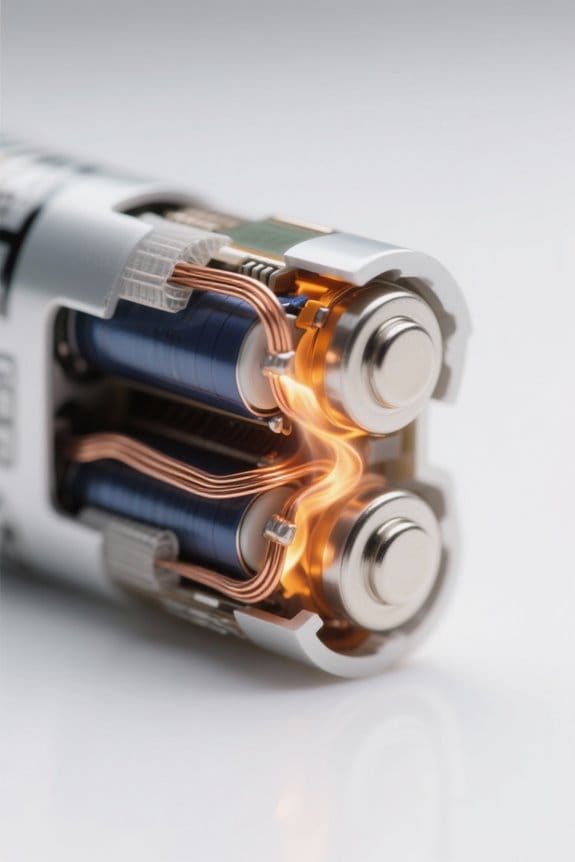
Internal resistance represents a critical factor in the generation of heat within batteries during charging, as it directly influences power dissipation through Joule heating, quantified by the equation P = I²R. For instance, a battery with an internal resistance of 77 milliohms subjected to a 17-ampere current can produce approximately 22.253 watts of heat, greatly elevating temperature during charging. Internal resistance tends to increase with battery age and wear, intensifying heat generation and reducing charging efficiency. Additionally, as the state of charge approaches full capacity, rising internal resistance further contributes to warmth by hampering energy conversion. Elevated heat resulting from increased internal resistance can degrade battery performance, accelerate capacity loss, and shorten battery life. Poor quality or damaged batteries often exhibit excessive internal resistance, indicating potential failure through abnormal heat generation during charging cycles. Many 12V outdoor lighting systems also rely on efficient power management to avoid overheating and ensure longevity of their components.
Recommended Products

【Powerful and Save Space】: 450W monocrystalline solar panel can produce up to 2250Wh of electricity per day with smaller space compared to 4pcs 100W or 2pcs 200W solar panels

Self-Heating Function: Automatically activates when charging at -20C to 5C (-4F to 41F). Choose between Regular and Energy-efficient heating modes via the LiTime APP for optimal cold-weather performance

[Ideal Output Power-6.24KWh/day]: This 1600W solar panel complete system generates about 6.24KWh per day under 4 hours full sunlight condition, very suitable for home, shed, cabin, and it provides enough power for air condition, TV, refrigerator, coffee maker, microwave and other AC 110V/120V devices.
Impact of Charger Efficiency on Battery Temperature
Although charger efficiency primarily hinges on the ability to convert voltage and regulate current with minimal loss, even small inefficiencies can provoke significant heat production that raises battery temperature during charging. For instance, a MOSFET such as the IRF540PBF-ND with an Rds On of 77 mOhms at 17A creates power loss near 22.253 Watts, directly contributing to the heat generated. Reduced charging efficiency as batteries near full capacity causes extra current flow, further increasing heat without improving battery performance. Poor-quality chargers exacerbate excessive heating by failing to minimize energy loss, risking damage due to insufficient heat dissipation. Consequently, monitoring charger efficiency is essential to prevent harmful temperature rises and maintain ideal battery health over time, thereby ensuring both safety and longevity. Many smart battery chargers include thermal sensors that adjust charging based on ambient temperature, optimizing performance and reducing heat production.
Recommended Products

Ideal for Premium Property Owners: The Yarbo Lawn Mower Pro features modular design, strong cutting system and fully autonomous navigation for low-effort, reliable lawn care. It cuts thick, wet, overgrown grass with ease, suitable for homes, golf courses, turf farms, luxury hotels and resorts.

【Massive Whole-House Energy Bank】Eliminate power anxiety with the DATOUBOSS 48.24 kWh battery system. This high-capacity 314Ah setup provides enough stored energy to run critical household appliances—including HVAC systems, refrigerators, and pumps—during extended grid outages or for full off-grid living.

[All-Scenario Power] - Apex 300 (2764.8Wh, 3840W) keeps homes lit, RVs rolling & off-grid sites running. Parallel 2-3 units (5.5-8.3kWh), expand to 58kWh with B300K. Never powerless.
Effects of Battery Chemistry on Charging Heat
Several battery chemistries, including lead-acid, lithium-ion, and nickel-metal hydride, demonstrate distinct thermal behaviors during charging, primarily due to differences in their internal resistance, chemical reaction pathways, and charging kinetics; for example, lithium-ion cells typically exhibit internal resistances below 50 milliohms, which is considerably lower than the 100–150 milliohm range observed in lead-acid batteries, leading to correspondingly reduced heat generation under comparable charging currents. Charging the battery causes chemical reactions within the cells that are endothermic, absorbing heat, yet internal resistance, particularly in older or degraded cells, generates additional heat, potentially causing high temperatures. Lithium-ion batteries tend to produce less heat due to their efficient ion movement, but excessive heat above 40°C can signal chemistry or charging issues. Consequently, battery chemistry markedly influences heat production during the charging process. NiMH rechargeable AA batteries offer high capacity and cost-efficiency, but they may produce more heat during charging compared to lithium-ion batteries due to their higher internal resistance and less efficient charging kinetics.
Influence of Charging Current and Voltage on Heat Production
Building upon the impact of battery chemistry on heat generation, the charging current and voltage represent additional critical factors that dictate thermal outcomes during charging sessions. Heat production increases considerably as charging current rises, due to I²R losses stemming from internal resistance within the battery and charger components; for instance, a 17A charging current can cause considerable power dissipation when internal resistance is not minimal. Furthermore, charging voltage exceeding the battery’s rated value forces higher current flow, which amplifies internal resistance effects and energy loss as heat. Lithium-ion batteries exhibit efficient performance up to certain current thresholds, beyond which heat production escalates disproportionately. Effective thermal management relies on monitoring both charging voltage and current to limit excessive heating, thereby preserving battery longevity and ensuring safety during operation. An important aspect of maintaining battery performance is the regular use of cleaning tools to prevent corrosion and prolong battery life.
Recommended Products

Whole-Home Off-Grid Power: Still worried about power outages or unstable electricity? This system includes six 51.2V 100Ah LiFePO4 batteries and one 10000W MPPT hybrid inverter. It can support high-power appliances such as refrigerators and air conditioners, enabling stable whole-home power supply. It meets the needs of off-grid living and backup power, providing a reliable solution for energy independence.
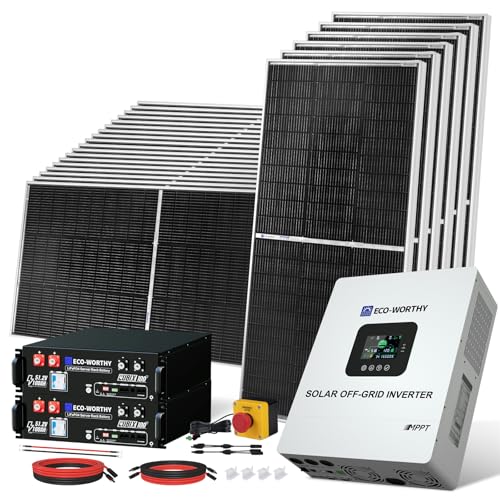
Full Off-Grid Solar Solution: Achieve energy independence with a robust renewable solution! Take control of your energy independence with the ECO-WORTHY comprehensive off-grid solar kit. This package includes two 48V 100Ah LiFePO4 integrated communication batteries, 24pcs 195W N-Type bifacial solar panels, and a powerful 5000W off-grid solar inverter equipped with a 100A MPPT solar charge controller, as well as all the necessary cables and mounting brackets.

elf-Heating Technology for Reliable Winter Performance: Equipped with an advanced self-heating function, the WT5100 51.2V 100Ah LiFePO4 battery automatically warms battery cells in low-temperature environments to support safer charging and improved winter performance. Compared with standard lithium batteries, this 48V server rack battery delivers more reliable power in cold climates, making it ideal for solar energy storage, off-grid systems, cabins, RV power, and home battery backup.
Common Signs of Excessive Battery Heating
When a battery undergoes excessive heating during charging, several recognizable indications may emerge, which, if monitored carefully, provide early warnings of thermal stress and potential failure. Excess heat often leads to noticeable swelling or deformation, signaling increased internal pressure and compromised structural integrity. An elevated surface temperature markedly above the normal operating range—typically exceeding 45°C—may indicate heightened internal resistance or abnormal charging currents. The presence of unusual odors or smoke suggests chemical reactions linked to overheating. Additionally, blackening or corrosion around battery terminals, especially the negative post, can reflect heat-related damage or overcharging. Voltage dropping below 12.5V during charging implies a shorted or failing cell, which exacerbates temperature rise and elevates the risk of thermal runaway if left unaddressed. To maintain optimal battery health, using a battery terminal cleaning tool can reduce contact resistance and prevent heat buildup.
Risks Associated With Battery Overheating
A critical risk linked to battery overheating involves the accelerated degradation of performance, wherein elevated temperatures surpassing 45°C trigger increased internal resistance and unwanted chemical reactions that markedly reduce capacity and runtime effectiveness by up to 30% compared to batteries maintained within ideal thermal conditions (20–25°C). High operating temperatures, often resulting from excessive current draw or the use of low-quality chargers, intensify heat generation and may provoke thermal runaway—a dangerous condition characterized by uncontrolled temperature rise that can cause swelling, fires, or explosions. Moreover, aging batteries with compromised internal components exhibit higher resistance values, leading to increased power dissipation and structural damage such as blistering or terminal blackening. Waterproofing capabilities can ensure better protection against environmental factors, which might otherwise contribute to overheating. Maintaining safe operating temperature ranges and avoiding excessive current loads are essential to mitigate these risks and preserve battery longevity.
Best Practices to Minimize Heat During Charging
Minimizing heat generation during battery charging greatly improves overall safety and longevity by addressing the issues related to elevated internal resistance and chemical instability that develop at temperatures exceeding 45°C. Implementing a battery management system (BMS) is critical for preventing overheating, as it continuously monitors temperature and adjusts charging speeds accordingly, optimizing thermal conditions. Users should avoid overcharging by stopping the charge once the battery reaches full capacity, reducing unnecessary heat production. Charging in shaded or climate-controlled environments further aids heat dissipation. Preconditioning the battery with gentle heating before charging can lower internal resistance, limiting temperature rise. Regularly monitoring state-of-charge with appropriate tools enhances control over the process. Together, these practices guarantee safer charging while extending battery lifespan through systematic temperature regulation and precise charge management. Additionally, using intelligent chargers with advanced safety features such as thermal sensors and reverse-polarity protection can prevent overheating and ensure optimal battery health.
Recommended Products

👍【REACH NEW FRONTIERS】Autel Robotics EVO Max 4T V2 perfectly integrates a wide camera, Zoom Camera, L~aser R~angefinder, and T~hermal Camera. Ultra-sensitive wide-angle camera supports 48MP 1/2" CMOS, max ISO 64000, Moonlight Algorithm 2.0 allows capturing crisp even in low-light environments. Zoom Camera supports 48MP 8K 10x optical zoom (160x Max). L~aser R~angefinder's Measuring Range: 16.4–3737 ft, Measuring Accuracy: ± (1 m + D×0.15%). T~hermal Camera with 640*512 30Hz t~hermal imaging and 9.1mm focal length and 16x digital zoom.

Expand Your Backup Capacity: Add B6000 Battery Module to extend E10 from 6kWh to 90kWh total. Each 6kWh module adds 1 day of essential backup. Stack up to 5 modules per E10 (30kWh max). Triple systems reach 90kWh for 15-day backup.
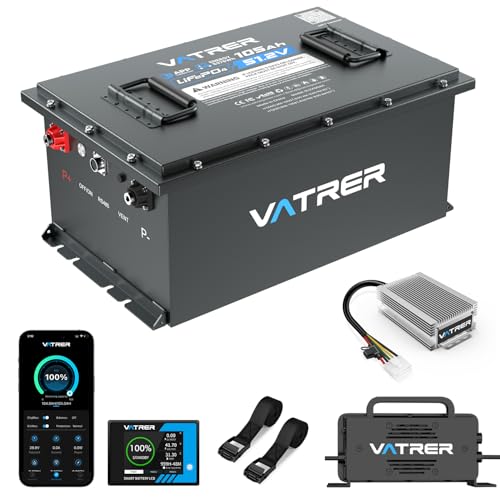
Officially UL2271 Certified by Intertek – Our 48V 105Ah lithium golf cart battery passes rigorous third-party safety testing per the official LEV lithium battery standard. It fully resists overcharge, short circuit, thermal runaway, vibration and impact, eliminating fire & explosion risks for daily golf cart use, fully compliant with US market safety regulations.
Importance of Proper Charger Selection
Although improper charger selection may seem a minor consideration, it directly influences battery temperature regulation and operational safety by determining voltage and current delivery parameters that must align with battery chemistry and capacity specifications. Selecting a charger rated for the battery’s Cold Cranking Amps (CCA) or equivalent capacity helps maintain battery health by preventing excessive heating from overcurrent conditions. High-quality chargers with microprocessor control dynamically adjust the charging current, which reduces overheating risks compared to constant current models that supply continuous, unregulated current. The absence of float or trickle charging phases in improper chargers further contributes to poor temperature management and accelerated battery wear. Regularly verifying compatibility between charger output settings and battery requirements guarantees efficient charging, minimizing heat generation and extending battery lifespan while maintaining overall operational safety. Additionally, models with interchangeable tips offer versatility and ensure compatibility with various devices, as highlighted in the top-rated chargers for 2026.
Recommended Products

Ultra-portable, battery-powered, advanced diagnostic trailer ABS and light tester

Unique display where characters reverse direction depending on measurement mode you are in

COMPLETE SUMP SYSTEM: include 12 amp battery charger, 12-volt 3180 gph backup pump, 115-volt 4020 gph automatic sump pump, diaphragm switch, pipe fittings and battery box (battery not included)
Monitoring and Managing Battery Temperature During Use
Because battery temperature directly affects performance and longevity, continuous monitoring during charging and use is essential to preventing thermal runaway and capacity loss; temperatures exceeding 40°C often signal inefficient charge regulation or deteriorating internal cells, necessitating immediate diagnostic evaluation through infrared thermography or embedded thermistors, which provide voltage, current, and thermal readings integrated within advanced Battery Management Systems (BMS). Monitoring battery temperature allows early detection of excessive heat resulting from increased internal resistance, especially in aged or degraded batteries. A robust battery management system actively regulates temperature by adjusting charge rates and managing discharge cycles. Additionally, optimizing the charging environment—such as selecting shaded, cooler locations—reduces heat accumulation, enhancing longevity and safety. Regular inspection and temperature tracking prevent irreversible damage, maintaining battery efficiency and ensuring reliable performance over time. Smart integrations with Victron devices enhance performance, delivering detailed insights via mobile app interfaces, further aiding in the precise management of battery temperature and overall health.
Frequently Asked Questions
Is It Normal for Batteries to Get Hot When Charging?
It is normal for batteries to get warm during charging due to battery chemistry and charging speed. Proper heat dissipation and safety precautions minimize performance impact, ensuring efficient operation without compromising battery longevity or safety under typical usage conditions.
What Does It Mean When Batteries Get Warm?
When batteries get warm, it’s as if they’re hosting a miniature furnace. This heat generation reflects battery chemistry, energy efficiency, and temperature regulation; proper lithium-ion safety guarantees warmth stays manageable, not catastrophic.
Is It Bad if My Battery Is Hot?
A hot battery raises concerns about battery safety, as overheating causes reduced charging efficiency and potential long term effects like degradation or damage. Preventing damage involves proper chargers and monitoring temperature to avoid risks such as thermal runaway.