As an Amazon Associate, we earn from qualifying purchases. Some links on this site are affiliate links at no extra cost to you. Our recommendations are based on thorough research and editorial judgment.

Understanding Charge Cycles and Battery Health Monitoring

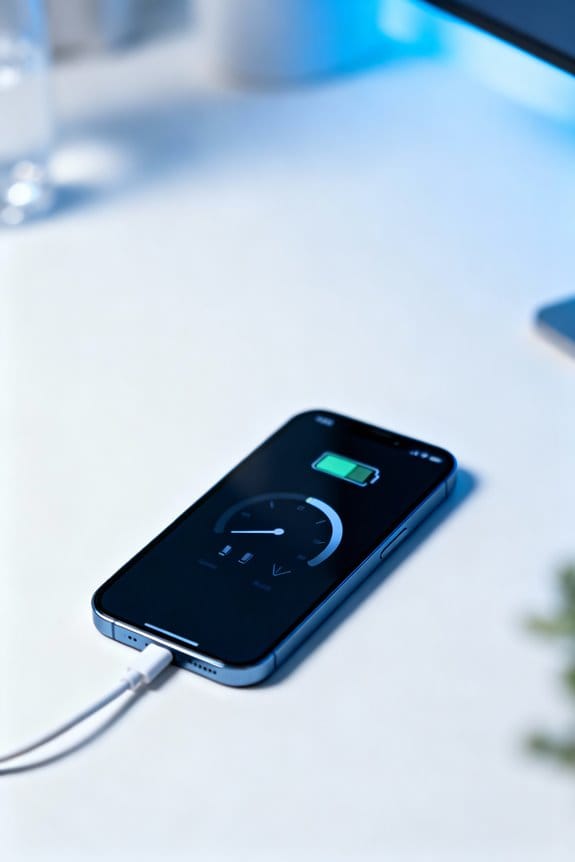
Battery charge cycles denote a full discharge and recharge from 0% to 100%, notably impacting lithium-ion smartphone batteries, which typically hold 1,800 to 3,100 mAh. Modern devices, like the iPhone 15, sustain over 1,000 cycles while retaining approximately 80% capacity, in contrast to earlier models like the iPhone 14. Monitoring voltage (3.0–4.2 V), current, temperature, and state of health (SOH) with battery management systems is essential for optimizing longevity and performance. Additional insights clarify how to assess battery degradation effectively.
Key Takeaways
- A battery charge cycle is one complete discharge and recharge from 100% to 0% and back to 100%, affecting battery lifespan.
- Lithium-ion batteries chemically degrade with each cycle, resulting in gradual capacity loss and reduced performance over time.
- Monitoring voltage, current, and temperature helps estimate the State of Charge (SOC) and State of Health (SOH) of batteries.
- Battery Management Systems (BMS) provide real-time health data, enabling optimized usage and early alerts for battery issues.
- Maintaining charge between 20% and 80% and storing devices properly extends battery life and preserves overall health.
Definition of Battery Charge Cycles
A battery charge cycle represents a full sequence in which a lithium-ion battery discharges from 100% capacity down to 0% and is subsequently recharged back to 100%, although it can also be composed of several partial discharges that cumulatively equal one full cycle. Modern batteries, including those in iPhones, typically endure between 300 and 1,000 battery cycles before noticeable capacity loss affects battery health and battery performance. For instance, after approximately 500 full charge cycles, iPhones generally retain about 80% of their original capacity, while newer models like the iPhone 15 can maintain this capacity beyond 1,000 cycles. Each charge cycle induces chemical and physical changes that gradually degrade capacity, impacting overall battery lifespan and necessitating cycle tracking to monitor performance effectively. Monitoring charge cycles is crucial for understanding battery longevity and optimizing device usage to extend its effective life.
How Lithium-Ion Batteries Work

Although lithium-ion batteries are commonly recognized for their widespread use in portable electronics, their operation hinges on a sophisticated electrochemical process involving the movement of lithium ions between the anode and cathode through an electrolyte during charge and discharge cycles; this ion transfer facilitates energy storage and release, with typical capacities ranging from 1,800 to 3,100 milliamp-hours (mAh) in smartphone batteries, such as those found in recent iPhone models. The battery’s performance depends on maintaining efficient ion movement, as capacity naturally decreases over time with repeated charge cycles. Continuous battery health monitoring provides critical data on state of charge (SOC) and state of health (SOH), enabling users to assess capacity degradation and optimize usage before performance issues arise, such as reduced runtime or unexpected shutdowns. Advanced battery monitors often feature low-voltage alarms and track temperature and internal resistance to ensure optimal battery performance and safety.
Impact of Charge Cycles on Battery Capacity

Since battery capacity directly corresponds to the number of full charge cycles completed, it is essential to understand that lithium-ion cells typically tolerate between 300 and 1,000 charge cycles before showing significant degradation in their energy storage capabilities; these cycles are accumulated through either complete discharges from 0% to 100% or by combining multiple partial discharges. Each charge and discharge cycle gradually reduces battery capacity due to chemical aging. For instance, iPhone 14 models retain about 80% capacity after 500 full cycles, while iPhone 15 models reach this milestone at 1,000 cycles. Effective battery management systems play a critical role in monitoring battery health by accurately tracking battery cycle counts and mitigating factors like frequent deep discharges, thereby helping to extend battery life and maintain peak performance over time. Additionally, maintaining optimal battery performance often involves protecting batteries from extreme temperatures which can accelerate capacity loss and reduce lifespan.
Recommended Products

Sony USA Authorized. Bundle Includes: Sony FX6 Digital Cinema Camera Kit with 24-105mm Lens + Sony FE 70-200mm f/2.8 GM OSS II Lens, Sony 160GB CFexpress Type A TOUGH Memory Card, Sony BP-U35 Battery, 3 Piece Filter Kit, Graduated Color Filter Kit, Tulip Lens Hood, Large Bag, Memory Card Wallet, Cleaning Kit, HDMI Cable, Lens Cap Keeper

Quick-release CCU docking system for fast, efficient job set-up

Items Included: 1 x Sony FX6 Full-Frame Cinema Camera (Body Only), 1 x Large Bag, 1 x Memory Card Wallet, 1 x Cleaning Kit
Monitoring Voltage, Current, and Temperature
While managing battery health involves many factors, close monitoring of voltage, current, and temperature remains fundamental for ensuring reliable performance and longevity; accurately measuring voltage, which typically ranges between 3.0 and 4.2 volts in lithium-ion cells, helps estimate State of Charge (SOC) by reflecting the proportion of remaining energy relative to full capacity. Monitoring voltage alongside current flow, which tracks energy entering or leaving the battery, supports precise SOC and State of Health (SOH) calculations, ensuring consistent battery performance. Temperature monitoring is also critical, as deviations from ideal operating conditions accelerate degradation and reduce efficiency. A Battery Management System (BMS) continuously measures these parameters, providing real-time data to maintain safety and efficiency, while alerting users to potential thermal stress or abnormal voltage and current levels to preserve battery lifespan. Advanced BMS solutions often feature real-time monitoring capabilities and offer mobile app integrations, enabling users to access performance data conveniently and respond to alerts promptly.
Understanding State of Charge (SOC)
Accurately interpreting voltage, current, and temperature data forms the foundation for defining the State of Charge (SOC), which quantifies battery capacity as a percentage relative to its nominal maximum. SOC functions similarly to a fuel gauge, representing available battery capacity and enabling effective management of energy consumption across various applications such as smartphones and electric vehicles. Battery health monitoring depends heavily on SOC assessment, as it fluctuates with charge/discharge cycles and battery aging, impacting overall battery performance. Self-discharge rates, influenced by temperature and aging, can reduce SOC independently of usage, complicating energy management. Precise calculation of SOC through voltage and current measurements guarantees ideal device operation and extends battery life by informing timely recharging decisions, thereby maintaining battery capacity and mitigating performance decline over successive charge/discharge cycles. Modern battery management systems often integrate multi-stage charging systems to optimize charging efficiency and protect battery health.
Understanding State of Health (SOH)
Although State of Charge (SOC) reflects the immediate energy available in a battery, State of Health (SOH) provides a critical measure of its long-term reliability by quantifying the ratio of current maximum capacity to the original nominal capacity established at manufacture. SOH decreases progressively as a battery undergoes repeated charge cycles, which directly influences battery lifespan and overall battery performance. For instance, lithium-ion batteries, such as those used in smartphones, often retain only about 80% of their original capacity after 500 full charge cycles, demonstrating typical SOH degradation. Monitoring SOH is essential, since diminished values imply reduced charge retention at effective voltages, resulting in shortened usage periods and higher risks of unexpected shutdowns. Therefore, continuous assessment of SOH enables informed decisions on maintenance and timely replacement, optimizing device reliability and user safety. Accurate and repeatable diagnostics using battery condition testers can significantly improve SOH monitoring and battery maintenance.
Effects of Chemical Aging on Battery Performance
The gradual decline in State of Health (SOH) directly reflects changes caused by chemical aging, which manifests as a reduction in battery capacity and an increase in internal resistance, negatively affecting overall performance. As batteries chemically age, their ability to hold charge diminishes, while internal resistance rises, causing voltage drops and diminishing power delivery. For instance, iPhone 14 batteries retain about 80% of capacity after approximately 500 charge cycles, whereas iPhone 15 models achieve similar retention after nearly 1000 cycles, indicating enhanced battery lifespan. Chemical aging also increases the likelihood of unexpected shutdowns under low charge or high-temperature conditions, further impacting battery health. Continuous monitoring of SOH and charge cycles is essential to assess battery performance degradation accurately and mitigate premature capacity loss resulting from chemical aging. Additionally, selecting batteries with features such as leak protection can help preserve battery integrity during prolonged use and storage.
Best Practices for Extending Battery Lifespan
A key strategy for extending lithium-ion battery lifespan involves maintaining charge levels within an ideal range, typically between 20% and 80%, since avoiding full discharge and complete charge cycles greatly reduces electrochemical stress and capacity degradation; this approach aligns with empirical data showing that iPhone models, such as the iPhone 14 and 15, achieve markedly different cycle life expectancies, with the latter sustaining approximately 1,000 charge cycles before notable performance decline compared to around 500 cycles for earlier models. Additional best practices include monitoring battery health regularly via device settings to detect capacity reduction early, and minimizing exposure to high temperatures to preserve battery performance. Utilizing adaptive features like Optimized Battery Charging further supports extending battery life while maintaining peak performance across the battery’s usable lifespan. For devices using AA rechargeable batteries, selecting those with higher recharge cycle capacities can significantly enhance long-term efficiency and reduce replacement frequency.
Recommended Products

【3500mAh LONG-LASTING DURABLE】 NINMAX new upgraded 3500mAh lithium AA batteries high-performance constant output, using high-density materials to accumulate amazing energy.

720 pack of Bevigor Lithium AA Batteries

【Steady 1.5V Output】1.5V lithium AA battery maintains full voltage nearly to the end for steady performance, unlike alkalines that gradually lose power
Managing Battery Health in Mobile Devices
Maintaining peak battery health in mobile devices demands consistent monitoring and strategic charging habits to mitigate capacity loss and performance degradation over time; lithium-ion batteries, which power most smartphones, typically retain about 80% of their total capacity after completing 500 full charge cycles, with newer models like the iPhone 15 doubling this expectancy to around 1,000 cycles before noticeable decline. Proper battery health management entails keeping charge levels between 20% and 80%, thereby reducing chemical stress and extending battery longevity. Users can track battery condition in device settings, where alerts signal significant degradation requiring replacement to preserve device performance. Additionally, storing devices at approximately 50% charge in cool, dry environments safeguards capacity. These measures collectively optimize battery condition, ensuring sustained device performance and prolonging battery lifespan across charge cycles. For safe disposal and recycling, it is important to use dedicated battery recycling containers that meet regulatory safety standards to prevent hazards and environmental damage.
Recommended Products

Comfortable Ride: WHILL Model C2, suitable for active individuals up to 300 pounds, features adjustable seat height and back support angles, with 3 seat widths (16", 18", 20"). Ensure maximum comfort during use. Color/size variations available.

Comfortable Ride: WHILL Model C2, suitable for active individuals up to 300 pounds, features adjustable seat height and back support angles, with 3 seat widths (16", 18", 20"). Ensure maximum comfort during use. Color/size variations available.
Comfortable Ride: WHILL Model C2, suitable for active individuals up to 300 pounds, features adjustable seat height and back support angles, with 3 seat widths (16", 18", 20"). Ensure maximum comfort during use. Color/size variations available.
Role of Battery Management Systems (BMS)
Although responsible for behind-the-scenes operation, battery management systems (BMS) play a critical role in monitoring lithium-ion battery parameters such as voltage, current, and temperature, thereby preventing hazardous conditions like overcharging beyond 4.2 volts per cell, deep discharging below 2.5 volts, and overheating above 45°C; by continuously evaluating State of Charge (SOC) and State of Health (SOH), these systems optimize charge/discharge cycles, contribute to prolonging battery lifespan from typical ranges of 500 to over 1,000 cycles, and provide timely alerts for replacements when health indicators fall below preset thresholds, enhancing both safety and performance reliability for mobile devices and electric vehicles alike. The BMS’s systematic monitoring not only safeguards battery health but also improves battery longevity and overall battery performance by managing usage and preventing damage effectively. Using components with UV-stabilized materials designed to withstand harsh environments further contributes to the durability and reliability of battery systems in outdoor or demanding conditions.
Recommended Products

Battery resistance, dc and ac voltage, dc and ac current, ripple voltage, frequency and battery temperature

Canon USA Authorized. Items Include: Canon EOS R5 Mark II Mirrorless Camera | 45MP Full Frame Sensor 8K Video Recording, Canon RF 100-500mm f/4.5-7.1L IS USM Lens, 64GB SF-G TOUGH Series UHS-II SDXC Memory Card, Canon EOS 200ES Shoulder Bag

-4℉ Low-Temperature Charging Capability: Special low-temperature electrolyte enables safe charging in extreme cold without cell damage, supporting reliable operation down to -4℉ and delivering 6,000+ long-life cycles.
Identifying Signs of Battery Degradation
How can users discern the onset of battery degradation in their devices, given subtle yet measurable indicators? Battery degradation typically manifests as a reduction in maximum capacity, with iPhone models, for example, retaining about 80% capacity after 500 charge cycles for iPhone 14, and 1,000 cycles for iPhone 15 and newer. This decline, measurable through built-in diagnostics, often accompanies notifications stating, “Your battery’s health is greatly degraded,” prompting replacement to sustain peak battery performance. Additional signs include increased unexpected shutdowns, especially under low charge or cold conditions, and diminished battery life between charges, reflecting chemical aging and higher internal impedance that impairs voltage stability. Monitoring such parameters allows users to objectively assess battery health deterioration, facilitating informed decisions before critical performance loss occurs.
Tools and Techniques for Battery Health Monitoring
Devices and software applications offer a range of tools and techniques to monitor battery health with increasing precision, allowing users to evaluate critical metrics such as cycle count, state of health (SOH), and remaining capacity; for instance, iPhones running iOS 11.3 or later incorporate built-in diagnostics accessible via Settings, providing real-time data on battery performance degradation, while third-party applications can complement this by delivering detailed analyses, including estimated lifespan predictions based on historical usage patterns. Advanced monitoring incorporates fiber-optic sensors and machine learning algorithms to enhance predictive analytics, facilitating proactive management. Tracking charge cycles is essential, as lithium-ion batteries typically lose capacity after 500 to 1,000 cycles. Maintaining stable operating conditions during charging optimizes battery health, preserves capacity, and extends overall lifespan, ensuring consistent performance throughout the device’s lifecycle.
Recommended Products

HPE SMART CHOICE PROLIANT MODEL P86726-005: Preconfigured and factory-tested for reliability, this Smart Choice model includes Intel Xeon 6325P (4 cores, 3.50 GHz), 32GB DDR5 ECC memory, 2 x 960GB SATA SSDs, dual 500W Flex Slot power supplies, HPE MR216i-p Gen11 storage controller, and an embedded 1GbE 4-Port Ethernet adapter—ready for immediate deployment

Whole-Home Backup: With 7200W to 14400W expandable output and 5kWh to 60kWh capacity, the Solar Generator 5000 Plus powers your whole home for over 1 day with a single unit. Based on average daily electricity usage during blackouts in American households, when expanded to 30kWh, it provides backup for up to 7 days, and with 60kWh, it can last up to 15 days.

Comfortable Ride: WHILL Model C2, suitable for active individuals up to 300 pounds, features adjustable seat height and back support angles, with 3 seat widths (16", 18", 20"). Ensure maximum comfort during use. Color/size variations available.
Frequently Asked Questions
Does the Charge Cycle Affect Battery Health?
Charge cycles wield power like a battery’s heartbeat, profoundly influencing lithium-ion battery longevity factors. Understanding charge cycle definition, ideal charging practices, battery maintenance tips, and impact of temperature is essential to preserving battery health and ensuring lasting performance.
Is 20 to 90 a Good Charge Cycle?
The 20 to 90 battery charging range is ideal, minimizing cycle impact and enhancing energy efficiency. Maintaining these charge limits supports better user habits, promoting an ideal battery lifespan and reducing strain compared to full 0-100% cycles.
Is 300 Charge Cycles Good?
A count of 300 charge cycles is moderate, reflecting average battery longevity. It suggests some capacity degradation may occur. Effective cycle management and charge efficiency, influenced by usage patterns, are essential to meet lifespan expectations and optimize battery performance.
How Many Charge Cycles Is a Battery Good For?
A lithium technology battery typically offers around 500 to 1000 charge cycles before battery performance declines considerably. Battery lifespan depends on charging habits and battery maintenance, which are essential for preserving ideal capacity and extending overall battery health.