As an Amazon Associate, we earn from qualifying purchases. Some links on this site are affiliate links at no extra cost to you. Our recommendations are based on thorough research and editorial judgment.
How to Connect Multiple String Light Strands Safely

To connect multiple string light strands safely, calculate total wattage by multiplying bulb wattage, sockets per strand, and strand count, ensuring it does not exceed 1080 watts; for example, LED strands at 1 watt per bulb allow up to 45 strands, while incandescent strands at 40 watts restrict connection to one. Use UL-listed, outdoor-rated extension cords rated for combined load, maintain proper wiring with voltage management, and regularly inspect for overheating or damage to reduce fire risk. Further guidelines improve long-term safety and performance.
Key Takeaways
- Calculate total wattage by multiplying bulb wattage, bulbs per strand, and number of strands to not exceed 1080 watts.
- Use LED strands, which consume less power, allowing more strands to connect safely on a single circuit.
- Verify socket count and wattage per bulb on each strand before connecting to avoid overloading the circuit.
- Utilize outdoor-rated, appropriately rated extension cords and multi-tap setups to distribute power without exceeding limits.
- Regularly inspect connections, bulbs, and cords for damage or overheating to maintain electrical safety during use.
Understanding Maximum Wattage Limits for String Lights
Exactly how many string light strands can be safely connected depends primarily on their total maximum wattage limit, which is 1080 watts, a critical threshold that must not be surpassed to avoid electrical hazards and guarantee safe operation. The maximum wattage is calculated by multiplying the individual bulb wattage by the number of bulbs per strand and then summing across all connected strands. For instance, LED bulbs consuming only 1 watt each allow connection of up to 45 strands (24 bulbs per strand times 45 strands equals 1080 watts), whereas incandescent bulbs, typically at 40 watts each, limit connection to one strand safely (40 watts times 24 bulbs equals 960 watts). Adhering to the specified maximum wattage is vital to prevent overheating, electrical fires, and guarantee long-term durability of lighting installations under continuous use. Additionally, choosing string lights with energy-efficient LED bulbs can significantly increase the number of strands safely connected due to their lower wattage consumption.
Calculating Total Wattage for Your String Light Setup
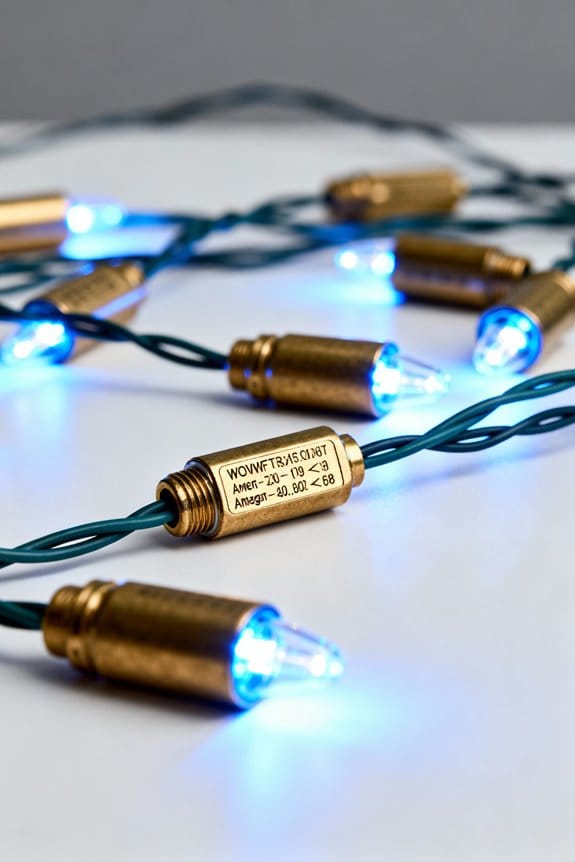
Calculating the total wattage of a string light setup requires multiplying the number of bulbs per strand by the individual bulb wattage and then multiplying that product by the quantity of connected strands, ensuring the cumulative wattage remains below the maximum threshold of 1080 watts to maintain safety and operational integrity. For example, a string with 24 sockets using 40-watt incandescent bulbs totals 960 watts per strand, limiting connections to just one strand. Conversely, LED bulbs typically consume about 1 watt each, allowing up to 45 strands with 24 sockets to approach 1080 watts safely. Accurate wattage calculations must factor in bulb type and quantity, as exceeding the maximum limit risks electrical overload, posing fire hazards or equipment failure. Monitoring cumulative wattage is essential for a secure, reliable lighting setup. Using an outdoor outlet box with GFCI protection can further enhance safety when connecting multiple string lights.
Differences Between LED and Incandescent Bulbs
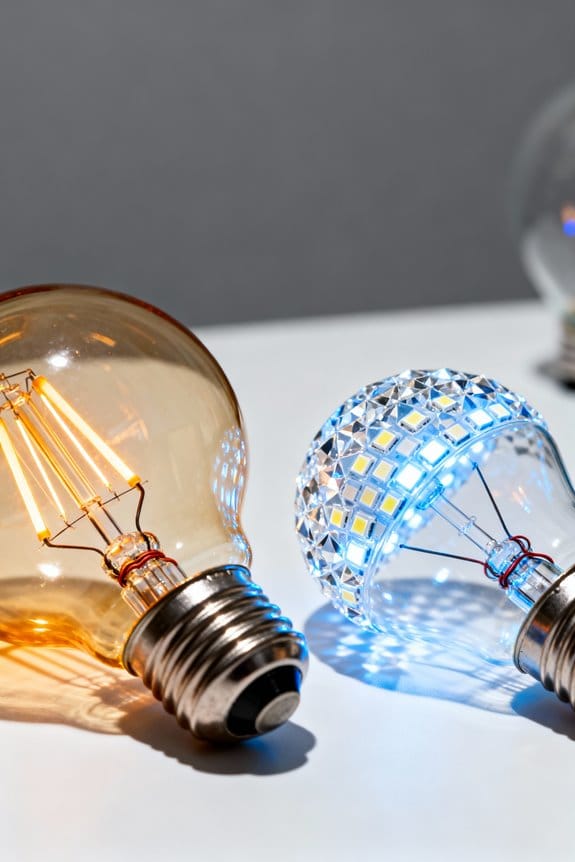
When selecting string lights for a setup, the choice between LED and incandescent bulbs greatly influences both energy consumption and connection capacity, with LED strands typically drawing between 1 to 10 watts per string, compared to the 50 to 100 watts commonly required by incandescent counterparts. LED lights consume considerably less power, enabling up to 144 strands to be connected on a standard 15-amp circuit, whereas incandescent lights limit this number to approximately 14 strings due to higher wattage. In addition, LED strings allow for up to 45 connections with 24 sockets while maintaining a maximum of 1080 total watts, supporting more extensive arrangements with reduced risk of overheating. While LED lights require a higher initial investment, their energy efficiency and lower operational wattage underscore their advantage in safe, large-scale string light configurations. Choosing LED string lights with a lifespan of over 25,000 hours can also minimize replacement costs and maintenance efforts.
Recommended Products

FESTIVE LIGHTING: Commercial outdoor Christmas decorations take a festive leap with this 250-foot C9 Christmas stringer bulk reel, sized to immerse your entire home in the holiday spirit.

FESTIVE LIGHTING: Commercial outdoor Christmas decorations take a festive leap with this 1,000-foot C9 Christmas stringer bulk reel, sized to immerse your entire home in the holiday spirit.

HOLIDAY MAGIC: Experience the holiday magic with our 250-foot C9 magnetic Christmas light spool, ideal for indoor and outdoor festive decorations.
Safe Strand Configuration and Socket Counts
Although multiple factors influence safe string light setups, attention to strand configuration and socket counts remains essential for mitigating electrical hazards; each strand’s wattage, calculated by multiplying the number of sockets by the wattage per bulb, must be carefully considered to guarantee the total connected load does not exceed the 1080-watt safety threshold. For example, LED string lights, consuming approximately 1 watt per bulb, support up to 45 strands with 24 sockets each (24 x 45 = 1080 watts). In contrast, incandescent lights using 40 watts per bulb dramatically limit connections to just one strand with 24 sockets (24 x 40 = 960 watts), staying safely under the maximum wattage. Evaluating both the wattage and the number of sockets per strand enables precise planning to maintain electrical safety during multi-strand configurations. For added protection, consider using overload protection features available in many outdoor light controllers to prevent circuit failure by automatically interrupting excessive current flow.
Recommended Products

ABOUT US : Urban Ambiance, Inc. is a U.S. brand of luxury, urban-inspired light fixtures, with company headquarters in Reno, NV. Each of our products meets or exceed U.S. standards for electrical safety and durability. With warehouses on both the East and West coasts, and friendly U.S.-based customer service, we encourage you to reach out and let us show you how we earn over 10,000 customers a year.

INCLUDES (1) Pre-installed Inline RGB Mini-Controller

[2400W Pure Sine Wave Output (4800W Surge) – Power Virtually Any Appliance] Delivers utility-grade electricity to run refrigerators, AC units, microwaves, coffee makers, power tools, CPAP machines, laptops, TVs, and 99% of household devices. The pure sine wave technology protects sensitive electronics from damage, while the massive 1843.2Wh capacity provides hours of runtime for high-wattage equipment. Ideal for whole-home backup during outages or powering workshop tools at remote job sites.
Guidelines for Connecting LED String Light Strands
Since LED string lights consume approximately 1 watt per bulb, it becomes feasible to connect up to 45 strands safely, provided each strand contains no more than 24 sockets, resulting in a maximum aggregated wattage load of 1080 watts. When linking LED strings, it is essential to verify each strand’s socket count and wattage to maintain total consumption below this threshold, thereby preventing electrical overloads. Because LED bulbs require considerably less power than incandescent counterparts, larger numbers of strands can be interconnected without exceeding safety limits. For strands with varying socket counts, calculations must adjust the wattage total accordingly. Accurate measurement of individual bulb wattage, combined with systematic wattage aggregation, guarantees safe, efficient operation. This attention to detail promotes reliable performance and minimizes fire or electrical hazards associated with improper LED string light connections. Additionally, selecting string lights with UL/ETL safety listings ensures compliance with rigorous safety standards during expansion.
Guidelines for Connecting Incandescent Light Strands
Unlike LED string lights, which can safely connect up to 45 strands due to lower individual bulb wattage, incandescent light strands present greater limitations because each bulb typically consumes up to 40 watts, restricting safe connections to generally one strand to keep total wattage below 1080 watts. When connecting incandescent lights, it is essential to calculate the total wattage by multiplying the number of bulbs by their individual wattage and ensuring the sum remains under this limit to prevent electrical overloads and potential hazards. Adhering to manufacturer guidelines about the maximum number of strands to link is critical, as wattage varies. Additionally, the use of heavy-duty, outdoor-rated extension cords is recommended to maintain safety standards when setting up these higher-wattage incandescent light strands. For maintaining device safety and longevity, consider using reliable power sources designed to handle higher electrical loads.
Power Supply Considerations for Multiple Strands
A key consideration for powering multiple string light strands involves verifying that the total electrical load, expressed in watts, remains within the maximum threshold of 1080 watts to avoid overloading circuits or causing voltage instability; this entails evaluating each strand’s wattage, such as 1 watt per LED bulb or up to 40 watts per incandescent bulb, and calculating the aggregate power consumption according to the number of sockets and strands connected. When using LED outdoor Christmas lights, which typically consume less power, users can safely connect up to 45 strands with 24 sockets, whereas incandescent light strings limit connections to one strand. Power supply considerations also include ensuring adequate current for multiple strings, monitoring if lights turn dim or overheat, and selecting outdoor-rated extension cords to safely connect two or more strings without exceeding max wattage. Additionally, many low voltage lighting kits feature transformers with built-in timers or photocell sensors to help manage power consumption efficiently.
Recommended Products

Flexible silicone cased tape light for enhanced Damp location listing. Peel and stick3 construction adhesive on back. Indicator marks every 6 inch for field cutting at the end of a run

Invisiled Pro 1Ft indicator marks every 2 inch for field cutting at the end of a run

Flexible silicone cased tape light for enhanced Damp location listing. Peel and stick3 construction adhesive on back. Indicator marks every 2 inch for field cutting
Best Practices for Wiring and Voltage Management
Optimizing wiring configurations and managing voltage carefully are essential steps when connecting multiple strands of string lights to prevent electrical hazards and maintain consistent illumination, especially during extensive outdoor installations where strand lengths and total wattage approach upper limits. It is vital to guarantee the combined wattage of all strings does not exceed 1080 watts, with LED bulbs typically allowing up to 45 strands per circuit due to their low, 1-watt consumption per bulb. Incandescent strings rated at 40 watts per bulb require more cautious planning, permitting only one strand per 24-socket set to avoid overload. Verification of manufacturer guidelines and proper distribution of electrical load across circuits further enhances safety, reduces voltage drop, and guarantees uniform brightness across connected strings, which collectively optimize performance and minimize the risk of overheating. Utilizing weather-resistant timers can further enhance safety and convenience in managing your outdoor lighting setup.
Recommended Products
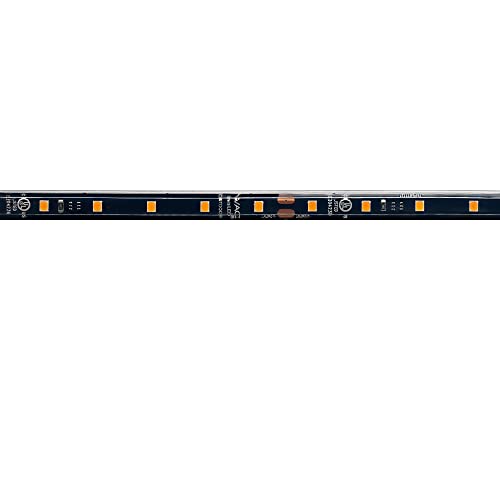
Available in 1.2W/ft and 2.4W/ft power options, 2700K(Warm)-3000K(Warm White)-4000K(Cool White) color temperature options, and 1ft, 5ft, 10ft, 20ft, 40ft, and 80ft (1.2W only) length options.
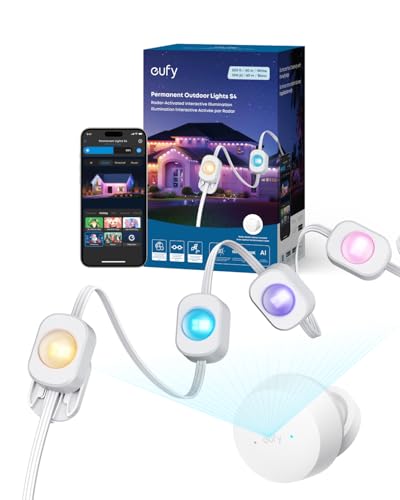
3-in-1 Lighting for Daily, Holiday, and Security: With 120°, 12 m radar coverage, this smart light strip offers precise motion detection for automatic lighting effects that follow your movement. Set customizable security alerts with flashing warnings to deter intruders.

REMOTE CONTROL, DIMMABLE NEW TYPENEON LED LIGHT: Brightness can be dimming from 10% to 100%, Perfect replacement for traditional Neon lighting of Structure outline such as Roofs, Windows, Doors, Storefronts and Carports. Suitable to home and garden lighting decoration
Using Extension Cords and Multi-Tap Solutions
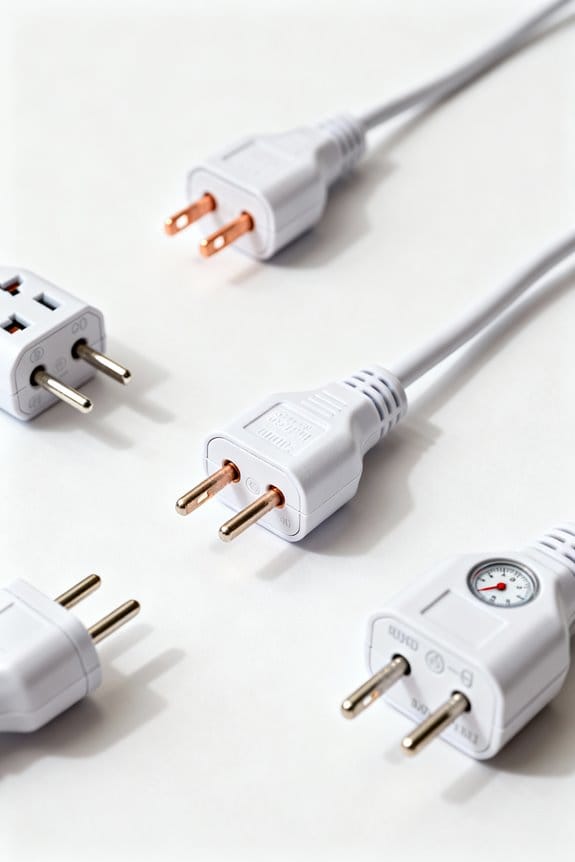
Utilizing outdoor-rated extension cords and multi-tap solutions is critical when arranging multiple string light strands across expansive areas to maintain safety and functionality, as these devices must withstand environmental exposure and electrical demands without failing. Extension cord safety mandates the use of cords rated for outdoor conditions, capable of handling the combined wattage of connected strands, with a focus on guaranteeing compliance with UL standards. Multi-tap extension cords facilitate parallel connections, distributing electrical loads and preventing overheating by adhering to manufacturer-specified maximum wattage limits. Additionally, power should be distributed across multiple circuits, each limited to 15 or 20 amps, to avoid circuit overloads. Properly managing these factors guarantees safe, reliable operation, minimizes fire risk, and extends the lifespan of string light installations in diverse outdoor settings. Selecting extension cords with the proper cord gauge rating is essential to safely handle the electrical load and reduce voltage drop.
Recommended Products

This selection is for 1,000 Feet of 14/4 SJOOW cable.

Meets the following UL and CSA standards for Flexible Cords and Cables: UL62 and CSA C22.2 . SOOW stands for S = Service Cord, OO = Oil Resistant (both inside and outside insulation), W = Weather and Water Resistant.
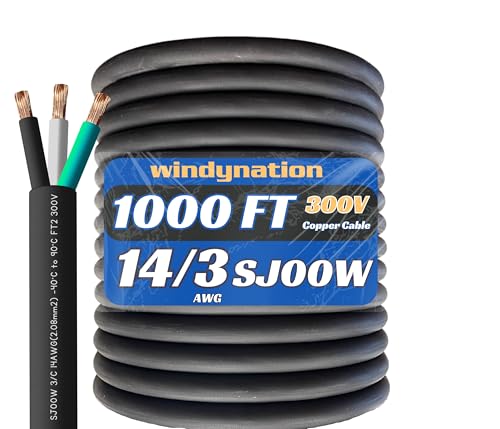
This selection includes 1,000 Feet of 14/3 SJOOW cable.
Monitoring and Maintaining Safe Operation of String Lights
Maintaining safe operation of string lights requires continuous vigilance, including confirming that the total wattage of connected strands does not exceed the 1080-watt threshold to prevent overload-related hazards, while routinely inspecting for signs of overheating, flickering, or electrical irregularities, which may signal developing failures. String light safety also demands using outdoor-rated extension cords and connectors, ensuring protection against environmental factors such as moisture and temperature variations that could degrade electrical components. Periodic examination of bulbs and connections for visible damage or wear is critical to prevent shorts or fire risks. In addition, if dimmers are incorporated, compatibility with specific string lights must be verified, as mismatches can cause malfunction or hazardous conditions. Effective monitoring, combined with precise adherence to wattage limits, substantially minimizes risks and extends the operational lifespan of string light installations. Selecting fixtures with high IP65+ weatherproofing and corrosion-resistant materials further enhances durability and safety in outdoor environments.
Frequently Asked Questions
How to Connect String Lights to Each Other?
String lights connect by securely plugging one strand’s end into another’s connector. Safety precautions include not exceeding wattage limits, using outdoor-rated cords, weatherproofing connections, and adhering to manufacturer guidelines to prevent electrical overload and hazards.
How Many Strings of Lights Can You Connect Without Blowing a Fuse?
The string capacity depends on bulb type and wattage. LED strands allow up to 45 connected safely, while incandescent limits to one strand per circuit. Exceeding the maximum wattage risks blowing a fuse and circuit overload.
How to Connect Multiple LED String Lights?
To connect multiple LED string lights safely, one must defy electrical chaos by meticulously monitoring String Light Safety—limit total wattage, use outdoor-rated cords, guarantee proper voltage, distribute circuits, and always follow manufacturer instructions for flawless, hazard-free illumination.
Should I Wire Multiple Lights in Series or Parallel?
Wiring methods favor parallel connections for multiple string lights, as they maintain consistent voltage across strands, simplify current management, and reduce overload risk. Series wiring increases total voltage requirements, complicating safe and efficient power use.