As an Amazon Associate, we earn from qualifying purchases. Some links on this site are affiliate links at no extra cost to you. Our recommendations are based on thorough research and editorial judgment.

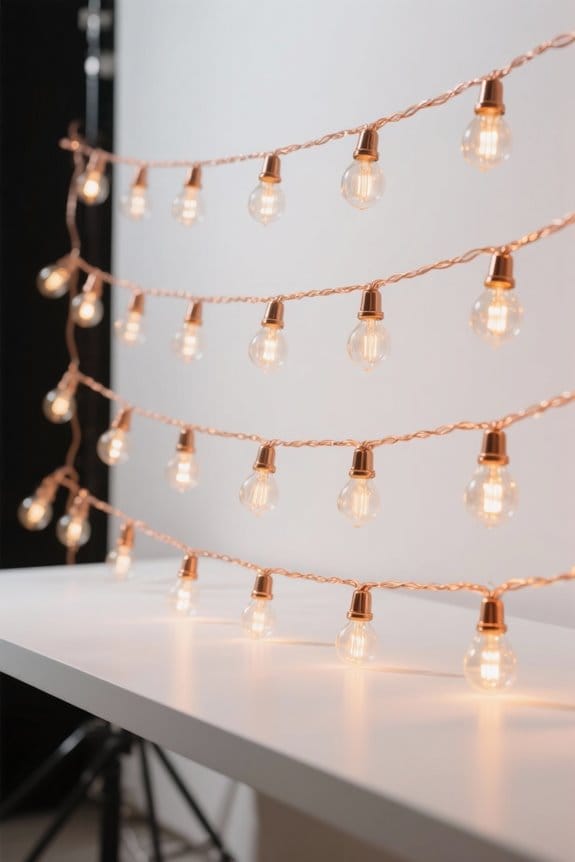
What to Know About String Light Spacing for Even Illumination

Ideal string light spacing for even illumination ranges from 12 to 24 inches, with E17 sockets requiring approximately 15 inches and E26 sockets about 24 inches, influenced by bulb wattage, size, and installation height; tighter spacing suits smaller areas for cozy warmth, while wider gaps prevent glare in larger spaces. Utilizing supporting cables reduces sagging and maintains tension, enhancing uniform brightness. Proper planning includes considering bulb type and weather resistance to guarantee durability and desired ambiance. Additional insights clarify adapting layouts to different environments.
Key Takeaways
- Maintain uniform spacing between bulbs, ideally 12-24 inches, to ensure consistent and even illumination throughout the area.
- Match bulb spacing to socket type, using about 15 inches for E17 sockets and 24 inches for E26 sockets for balanced light distribution.
- Consider installation height and adjust spacing wider for elevated setups to avoid overly bright or dark zones.
- Use zig-zag patterns for fuller, more even coverage compared to straight line or V-shaped arrangements.
- Ensure bulbs are evenly spaced and mounted at consistent heights to prevent dark spots and visual imbalance.
Optimal Bulb Spacing for Balanced Lighting
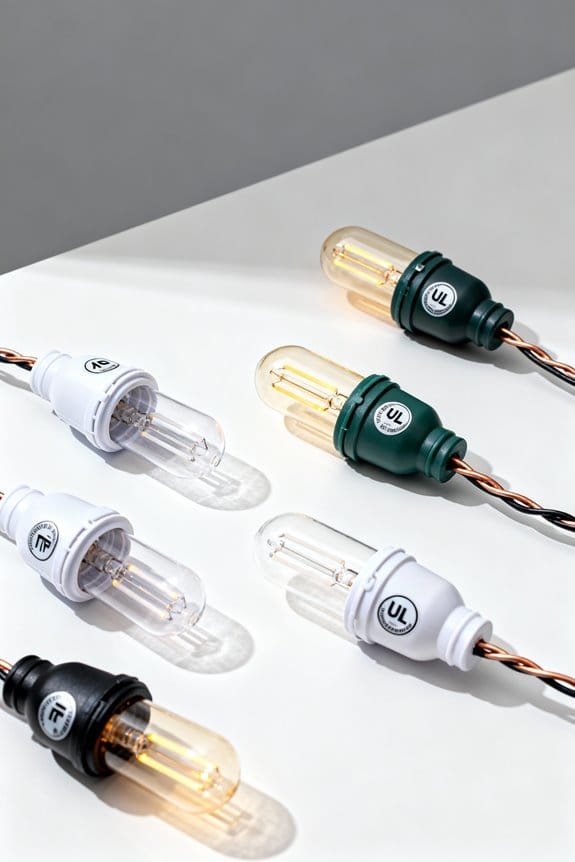
A range of 12 to 24 inches typically defines the ideal spacing for outdoor string light bulbs, balancing brightness and aesthetic appeal according to situational demands; for instance, café lights frequently utilize E17 sockets spaced at 15 inches, whereas E26 sockets are set at 24 inches apart to uphold consistent illumination. Advantageous bulb spacing enables even illumination with minimal shadows, ensuring an ambient glow that complements functional areas, including dining spaces requiring focused brightness. Larger bulbs, often mounted in E26 sockets, necessitate greater separation to prevent overpowering visual effects, while closer intervals suit the softer ambiance created by E17 sockets. Careful planning is essential, especially with extended lengths, to provide adequate support points that reduce sagging, maintaining string tension and preserving aesthetic integrity throughout installation and usage. Built-in hooks on each socket simplify easy installation, facilitating hassle-free setup while preserving the intended design.
Factors Influencing String Light Distance
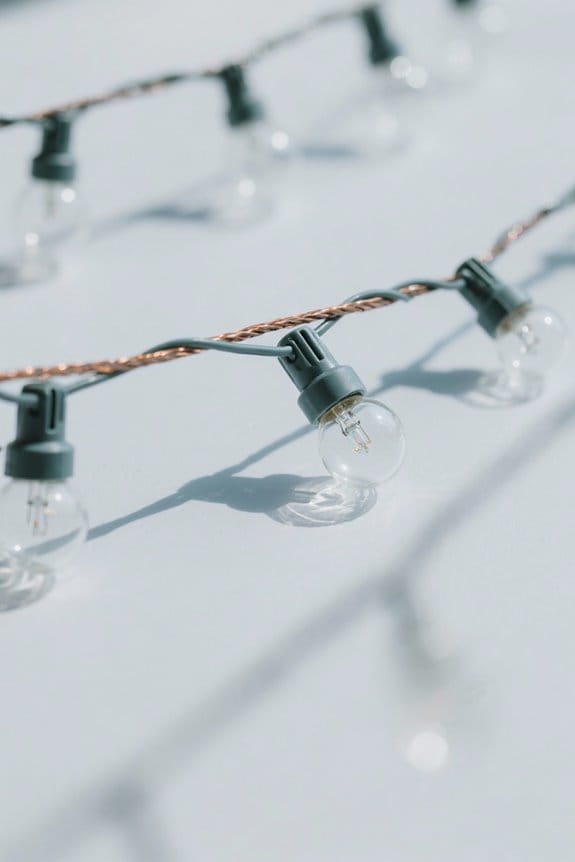
Although bulb spacing is commonly guided by general ranges between 12 and 24 inches, several factors fundamentally influence the ideal distance for string lights, including bulb wattage, installation height, and the physical environment; for example, higher wattage bulbs may necessitate greater spacing, typically near 24 inches, to prevent overpowering the area, whereas lower wattage bulbs spaced closer, around 12 to 15 inches, enhance ambient warmth without excessive brightness. Additionally, the overall height of light strands affects spacing choices, since elevated installations require wider gaps to maintain a consistent illumination effect. In larger areas, supporting cables minimize sagging, preserving visual balance and uniform spacing, which is essential for achieving a cozy ambiance across outdoor space. Differences in bulb size or style also demand adjusted spacing to sustain aesthetic harmony while optimizing light coverage. For outdoor string lights, weather resistance features such as IP65 ratings ensure durability in various climates, which can be crucial in deciding the placement and spacing to avoid damage from environmental exposure.
String Light Patterns and Their Effects on Illumination
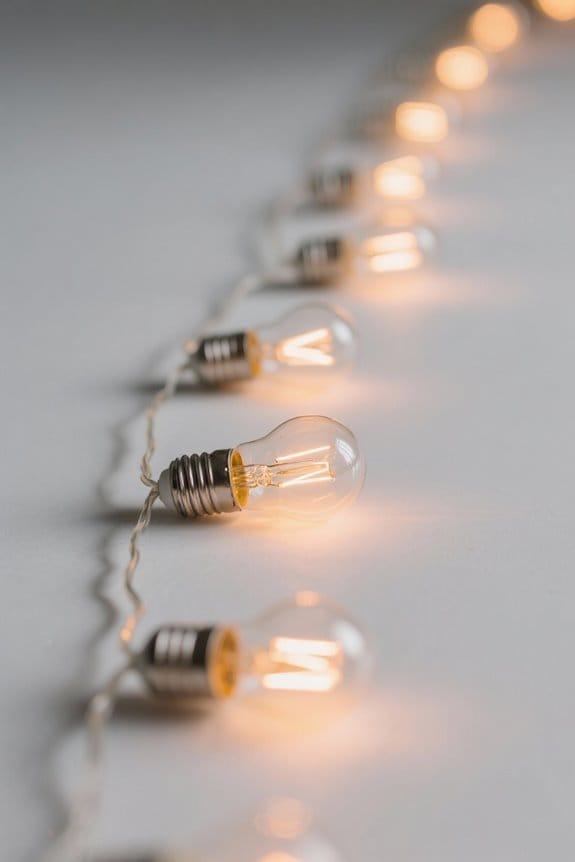
String light placement not only depends on spacing but also on the arrangement pattern, which considerably affects the distribution and intensity of illumination across a given area. Different string light patterns, such as zig-zag patterns, offer fuller coverage and enhance visual depth by dispersing light more evenly compared to straight or v-shaped layouts. Proper spacing between bulbs, typically ranging from 12 to 24 inches depending on bulb size and socket size, influences ambient lighting; for example, E17 sockets are spaced about 15 inches apart, while E26 sockets often measure 24 inches apart for outdoor lighting. Larger bulbs increase overall brightness, suited for expansive spaces, whereas smaller bulbs facilitate subtle illumination. Maintaining even spacing and consistent height within these patterns guarantees balanced illumination, preventing dark spots and minimizing perceived clutter in the outdoor lighting design. Warm-white bulbs (2,700-3,000K) are particularly effective in creating a romantic ambiance, which is essential for outdoor weddings and similar events.
Adjusting Spacing for Various Outdoor Spaces
Many outdoor environments demand careful adjustment of bulb spacing, with typical recommendations ranging from 12 to 24 inches to achieve consistent, even illumination; for instance, patios or backyards often utilize 24-inch intervals to minimize visual clutter while effectively lighting expansive zones, whereas smaller areas like balconies or decks benefit from tighter spacing near 12 inches to maintain a warm and inviting ambiance without excessive brightness. Proper light spacing is essential for balancing visual aesthetics and ambient lighting across diverse outdoor spaces. In larger areas, wider bulb spacing reduces redundancy, supporting more efficient coverage, while smaller spaces require denser bulbs to foster a cozy atmosphere. Uniform bulb spacing also enhances the aesthetic appeal and helps string lights produce a balanced glow critical for both decorative and functional purposes outdoors. For enhanced durability and year-round use, consider opting for shatterproof and waterproof outdoor string lights.
Impact of Bulb Type and Size on Spacing
A critical factor in determining ideal bulb spacing involves analyzing the bulb type and size, as variations such as E17 and E26 sockets necessitate distinct intervals of approximately 15 inches and 24 inches respectively to achieve balanced illumination without over- or under-lighting the area. Larger bulbs typically require wider spacing to prevent overwhelming smaller spaces, while smaller bulbs can be placed closer to produce uniform light distribution. LED bulbs, favored for energy efficiency and extended lifespan, often allow for different spacing compared to incandescent bulbs due to differing brightness and heat output. In commercial settings and expansive outdoor areas, industrial-grade LED string lights enable longer span installations with wider spacing, maintaining even illumination and a consistent ambient glow, which enhances both functional lighting and aesthetic appeal. It’s crucial to select fixtures with IP65+ weatherproofing for outdoor string lights to ensure durability and performance in various weather conditions.
Tips for Planning and Measuring String Light Layout
Careful planning and exact measurement form the foundation of an effective string light layout, requiring the accurate assessment of area dimensions combined with an allowance of 2 to 6 feet for proper swag and tension in hung lines to prevent sagging or overstretching. To guarantee ideal illumination, spacing string lights 12 to 24 inches apart is recommended, adjusted for bulb size and desired brightness. Sketching a rough design enables visualization of arrangements such as zig-zag, V-pattern, or grid styles, promoting uniform spacing and thorough coverage. It is essential to measure hanging points consistently, maintaining a clearance of 8 to 10 feet to avoid obstructions and enhance visibility. These precise steps guarantee that the string light layout achieves both functional illumination and aesthetic appeal. When considering options, prioritize IP65 waterproofing to ensure string lights can withstand outdoor elements, providing durable and reliable performance in all weather conditions.
Frequently Asked Questions
How Far Apart Should String Lights Be?
String light arrangements should ideally space bulbs 12 to 24 inches apart, balancing patio ambiance enhancement and event lighting design. Incorporating energy efficient options and customizable lighting designs enriches festive lighting ideas and outdoor decoration tips within seasonal lighting themes.
How to Evenly Space Light Fixtures?
Even fixture placement follows installation guides emphasizing hanging techniques for outdoor events, balancing lighting design and safety tips. Proper spacing enhances ambiance creation and garden decoration, ensuring illumination methods blend aesthetic appeal with functional fixture placement for uniform brightness.
How Far Apart Should Lights Be Spaced?
String light heights influence spacing, typically 12 to 24 inches apart, balancing festive lighting tips with backyard ambiance creation. For garden party arrangements, illuminating pathways or romantic atmosphere lighting, LED string options and lighting design principles guarantee ideal outdoor event decor.
What Is the Best Pattern to Hang String Lights?
As the saying goes, “Variety is the spice of life.” Choosing hanging techniques depends on string light styles, catering to outdoor ambience, party decorations, wedding setups, backyard lighting, indoor installations, or seasonal themes, while balancing energy efficiency and light bulb types.