As an Amazon Associate, we earn from qualifying purchases. Some links on this site are affiliate links at no extra cost to you. Our recommendations are based on thorough research and editorial judgment.

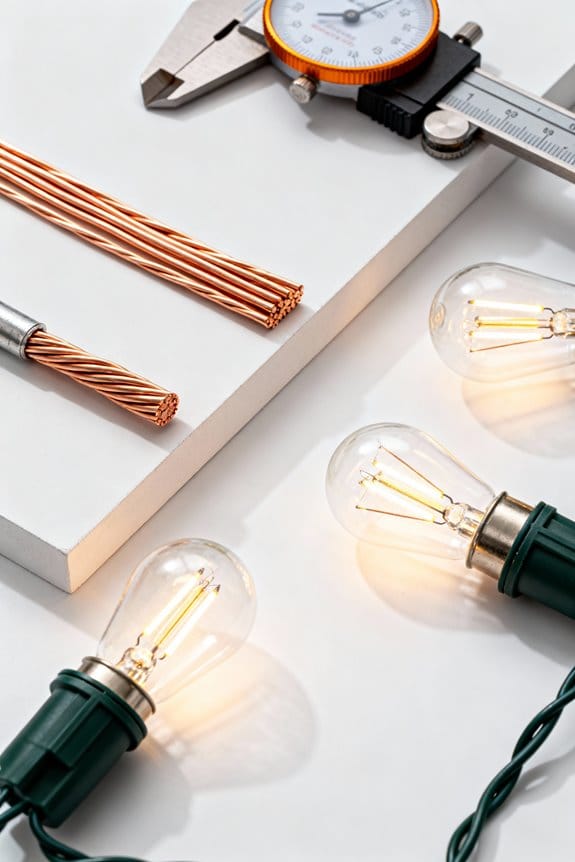
Understanding Wire Gauge and Its Impact on String Light Performance

American Wire Gauge (AWG) defines wire diameter, with lower numbers indicating thicker wires that safely conduct higher currents; for example, 18 AWG handles 10-15 amps, minimizing voltage drop to about 0.21 volts over 5 meters versus 0.53 volts for 22 AWG, which supports only 5-7 amps. Selecting the correct gauge, especially 16 or 18 AWG for lengths over 20 feet, prevents overheating and guarantees consistent lighting brightness. Proper understanding improves installation safety and efficiency, revealing further technical nuances.
Key Takeaways
- Wire gauge size affects electrical resistance, influencing string light brightness and preventing overheating risks.
- Thicker wires (lower AWG) reduce voltage drop, maintaining consistent light intensity over longer runs.
- 18 AWG is commonly recommended for standard string lights, supporting 10-15 amps safely.
- Using thinner wires like 22 AWG limits current capacity and increases voltage drop, causing dimmer lights.
- Proper gauge selection and weatherproof ratings improve string light performance and outdoor safety.
What Is American Wire Gauge (AWG)?
American Wire Gauge (AWG) is the standardized system primarily used in the United States to quantify the diameter of electrical conductors, where larger gauge numbers correspond to progressively thinner wires; for instance, a 14 AWG wire possesses a diameter of approximately 1.63 millimeters, allowing it to carry higher current loads compared to an 18 AWG wire, which measures about 1.02 millimeters in diameter. Wire gauge selection is critical because a thicker wire gauge offers lower resistance, which reduces voltage drop and improves safety by preventing overheating. Using an inappropriate gauge often results in higher resistance, increasing the risk of hazards and reducing peak performance. The AWG system encompasses sizes from thin residential wires up to industrially used “aught” sizes, which further support demands for durability and current-carrying capacity in various applications. Additionally, choosing the correct wire gauge is essential when powering devices such as string lights, which often require consideration of battery type compatibility to ensure optimal performance and longevity.
The Importance of Wire Gauge in Electrical Systems
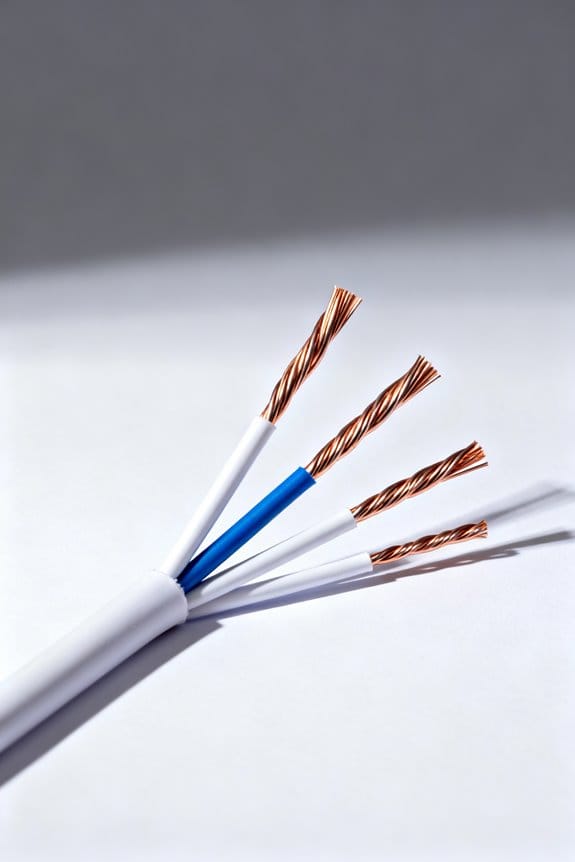
When selecting wire for electrical systems, the gauge size critically influences both safety and performance, with thicker wires such as 18 AWG capable of handling currents up to 10-15 amps, whereas thinner gauges like 22 AWG typically support only 5-7 amps; this variance affects resistance levels, voltage drop, and ultimately the efficiency of powered devices. Wire gauge measurement, expressed in AWG, determines the wire’s thickness and ability to reduce voltage drop, which is essential to maintaining brightness stability in LED lighting applications. Thicker wires minimize voltage drop, preventing performance issues such as dimming or flickering. Adherence to electrical codes is necessary to mitigate safety risks and guarantee that wire gauge selection suits the application’s current demands, thereby promoting both energy efficiency and durability in electrical systems. For outdoor applications, selecting an appropriate wire gauge like 14 AWG wiring is critical to ensure safe and reliable power delivery over longer distances.
How Wire Gauge Affects Current Capacity and Safety
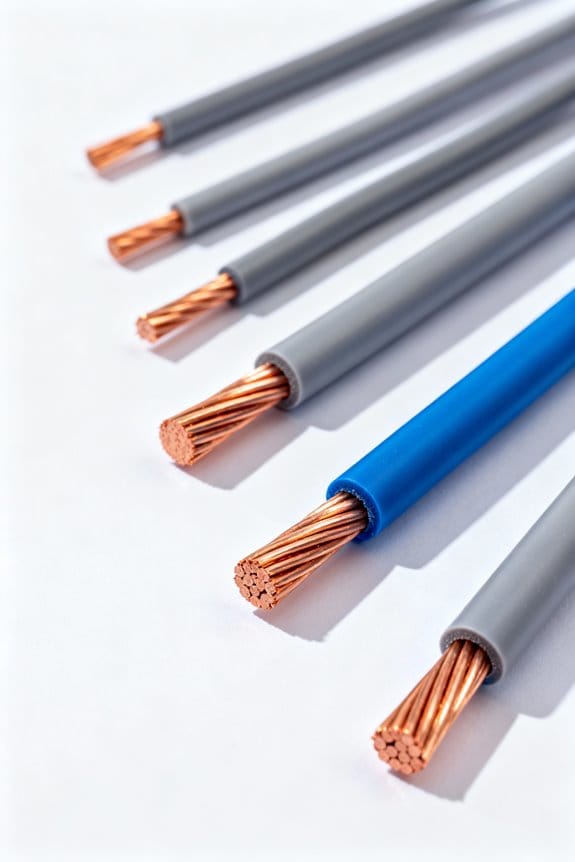
Although wire gauge is one of several factors influencing an electrical system’s performance, its role in determining current capacity and guaranteeing safety is paramount, as thicker wires, characterized by lower American Wire Gauge (AWG) numbers such as 12 AWG, accommodate currents up to 20 amps, whereas thinner wires like 22 AWG are limited to 5-7 amps; this differential capacity guarantees that high-power applications, including outdoor string lighting, operate within safe thermal limits, preventing overheating and potential fire hazards. Using the proper wire gauge reduces voltage drop, ensuring LED string lights receive sufficient voltage for ideal brightness while maintaining safety. Exceeding a wire’s ampacity compromises current capacity and increases risk. Thicker wires balance functionality and safety, emphasizing the importance of selecting appropriate wire gauge for durable, efficient lighting installations. For outdoor lighting projects, pairing the correct wire gauge with an IP67-rated power supply ensures reliable operation and protection against environmental elements.
Recommended Products

FESTIVE LIGHTING: Commercial outdoor Christmas decorations take a festive leap with this 250-foot C9 Christmas stringer bulk reel, sized to immerse your entire home in the holiday spirit.

Specification: 1000-Feet 12AWG*2C, Black, can reduce power drop, suitable for long distance landscape lights installation

FESTIVE LIGHTING: Commercial outdoor Christmas decorations take a festive leap with this 1,000-foot C9 Christmas stringer bulk reel, sized to immerse your entire home in the holiday spirit.
Typical Wire Gauges Used for String Lights
Wire gauge selection plays a critical role in determining both the electrical load capacity and the overall performance of outdoor string lights, with 18 AWG and 16 AWG wires being the most commonly used gauges; 18 AWG supports current loads up to 10-15 amps, making it ideal for standard lighting configurations, while 16 AWG accommodates higher currents required for larger or more power-intensive displays. Thicker wires like 16 AWG reduce voltage drop over extended lengths, ensuring consistent brightness in outdoor lighting setups. For shorter runs or low-power LED strip lights, gauges ranging from 20 to 22 AWG can suffice, but installation tips frequently recommend switching to 18 or 16 AWG beyond 20 feet to prevent overheating and loss of efficiency due to increased resistance. Hence, proper AWG selection balances safety, performance, and durability in string light applications. Additionally, choosing wire with durable insulation and color-coded wires improves ease of installation and long-term reliability.
Understanding Voltage Drop and Its Effects on Lighting
Voltage drop constitutes a fundamental challenge in electrical systems, representing the loss of electrical energy as current travels along a conductor, which can considerably impair the performance of string lights by causing dimming or flickering effects. The extent of voltage drop is influenced by wire gauge, where thicker wires—with lower American Wire Gauge (AWG) numbers—exhibit less resistance, reducing energy loss. For instance, over a 5-meter distance, 22 AWG wire may experience a 0.53V drop compared to just 0.21V with 18 AWG wire, making thicker wires preferable for maintaining brightness, especially in LED lighting systems. Ensuring voltage drop remains under 3% is critical for ideal performance and safety, emphasizing the importance of choosing the right wire gauge to meet specific power requirements and extend string light longevity without compromising illumination quality. Additionally, selecting components like battery holders with low-resistance metal contacts further helps minimize voltage sag in low-current applications.
Decoding Wire Labels and Conductor Counts for String Lights
After addressing the impact of voltage drop on string light brightness and efficiency, attention turns to the labels found on electrical wires, which communicate essential information regarding their size and conductor count. Wire labels like 14/2 or 12/3 denote the wire gauge (AWG) and the number of insulated conductors, vital for selecting appropriate wire sizes for LED and other string lights. The number before the slash indicates the AWG size, such as 14 or 12, determining current-carrying capacity, while the number after the slash specifies conductor counts, typically two for standard connections and three for more complex setups requiring additional circuits or higher wattages. Properly decoding these labels guarantees compatibility with electrical loads and helps mitigate voltage drop, thereby optimizing string light performance and safety in various installations. Additionally, choosing cables with the appropriate breaking strength ensures the physical durability and safety of the overall string light installation.
Selecting the Proper Wire Gauge Based on Distance and Power Requirements
Although the choice of wire gauge often depends on various factors, it primarily hinges on the distance of the run and the power requirements of the string light setup, as these directly influence current capacity and voltage drop. Selecting the right wire gauge guarantees ideal LED performance by minimizing voltage drop, preferably below 3%, which prevents dimming and inefficiency. For shorter runs under 20 feet with low power needs, 20-22 AWG wire suffices, while 18 AWG suits moderate-power bulbs at similar distances. Longer runs, such as 40 feet, require thicker wires like 16 AWG to sustain brightness without flickering. High-current setups exceeding 50 feet demand even thicker wires, such as 14 or 12 AWG, for safety and reliable operation. Consequently, thicker wires are essential for longer runs and higher power needs in string light configurations. Additionally, installing string lights with weather resistance in mind ensures stable performance and durability in outdoor conditions.
Recommended Products

330-Foot commercial grade light string - medium base socket

CREATE CUSTOMIZED LIGHT DISPLAYS - This professional grade 1000’ C9 cable has 2000 empty C9 sockets spaced 6 inches apart (plugs not included), allowing unique light string variations in lengths for any occasion. Use custom colors to represent Christmas or other holidays, team colors, party themes, and more.

MAGNETIC CHRISTMAS LIGHT STRINGER - The SPT-1 Magnetic Christmas Light Stringer is an excellent alternative to traditional Christmas light stringers. Each socket is a high-strength Neodymium magnet plated with a protective nickel coating that guards against rust. Safe for indoor and outdoor use. The wire on the spool does not come with cable ends (sold separately).
Common Mistakes to Avoid When Choosing Wire Gauge
When determining the appropriate wire gauge, many installers underestimate the risks associated with using wires that are too thin for high-power or extended-distance applications, which can result in excessive heat buildup and create fire hazards. Common errors include selecting 22 AWG instead of 18 AWG, despite the former’s limited current capacity of 5-7 amps versus 10-15 amps for the latter, increasing overheating risks. Ignoring voltage drop, especially beyond a 3% threshold, leads to dimming or flickering string lights. Additionally, overlooking the importance of wire insulation rated for outdoor environments compromises durability and safety. Failing to verify conductors—such as confusing 14/2 with 14/3 cables—also affects system performance, underscoring the necessity for precise wire gauge selection aligned with current needs and environmental conditions. It is also crucial to ensure the wire gauge and installation practices meet IP65 or higher standards for effective weatherproofing and safety outdoors.
Best Practices for Installing Wire in Outdoor String Lighting Systems
Because outdoor string lighting systems are subject to varied environmental conditions and electrical demands, selecting and installing appropriate wire gauges—such as 14 AWG for moderate distances under 50 feet or 12 AWG for runs exceeding 100 feet or circuits drawing up to 20 amps—is critical to maintain consistent current flow and minimize voltage drop below 3%, thereby preventing dimming or flickering effects. The wire gauge guarantees sufficient capacity for different sizes and applications, especially in longer runs where voltage drop becomes a concern. Secure, weather-resistant connections using wire nuts or terminal blocks instead of tape improve durability and safety. Additionally, adhering to ampacity limits prevents overheating, while regular inspection for wear or corrosion maintains ideal lighting performance. These best practices combine to enhance both efficiency and longevity in outdoor lighting installations. Choosing a controller with ETL certification ensures compatibility and safety for outdoor electrical systems.
Frequently Asked Questions
How Does Temperature Affect Wire Gauge Performance in String Lights?
Temperature coincidentally influences wire gauge performance by affecting conductivity and causing thermal expansion. Increased ambient heat reduces current capacity, raising voltage drop risks. Wire insulation integrity also suffers, ultimately impacting string light performance efficiency.
Can Wire Gauge Impact the Color Temperature of String Lights?
Wire gauge indirectly influences color temperature by affecting voltage drop and light intensity, which can alter color perception. Proper wire conductivity guarantees bulb compatibility and energy efficiency, especially with LED technology, maintaining consistent and accurate color temperature output.
What Is the Lifespan Difference Between Various Wire Gauges?
Lifespan comparison reveals thicker wire gauges generally offer enhanced longevity due to reduced power loss and improved material conductivity influence. Gauge longevity factors depend on application-specific gauges and proper maintenance recommendations to optimize wire thickness effects and performance.
Are There Environmental Regulations for Using Certain Wire Gauges Outdoors?
Ironically, not all wire gauges are legally free to wander outdoors; wire compliance demands gauge specifications and insulation materials meet rigorous environmental standards. Regulatory guidelines prioritize outdoor safety, ensuring wire durability against weather, reinforcing that careless wire use is not so carefree.
How Does Wire Flexibility Relate to Gauge Selection in String Lights?
Wire gauge impacts flexibility; thinner gauges offer enhanced flexibility but may reduce durability. Wire material and application types influence gauge selection, balancing flexibility benefits with durability considerations. Installation techniques and user preferences further guide ideal choices for string lights.