As an Amazon Associate, we earn from qualifying purchases. Some links on this site are affiliate links at no extra cost to you. Our recommendations are based on thorough research and editorial judgment.

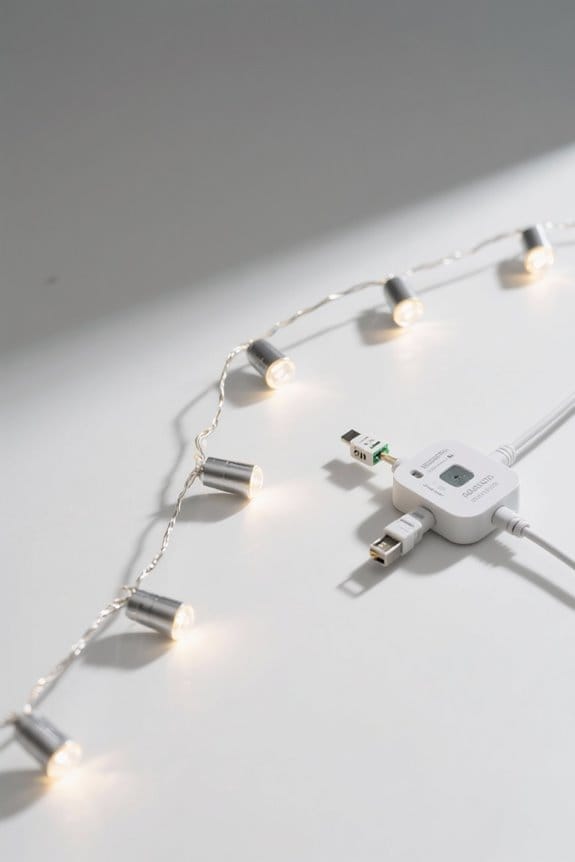
How Smart String Lights Integrate With Home Automation Systems

Smart string lights integrate with home automation systems primarily through Wi-Fi, Zigbee, or Z-Wave protocols, enabling centralized control via hubs like Philips Hue Bridge or Samsung SmartThings and smartphone apps. They offer precise adjustments in RGB color selection, dimming from 10% to 100%, and customizable schedules for energy efficiency and security enhancements. Voice assistant compatibility supports hands-free operation and routine automation. These features collectively improve synchronization with other smart devices, while advanced connectivity parameters guarantee reliable performance. Further exploration reveals detailed customization and troubleshooting strategies.
Key Takeaways
- Smart string lights connect via Wi-Fi, Bluetooth, Zigbee, or Z-Wave for seamless integration with home automation systems.
- Compatible hubs like Philips Hue Bridge or Samsung SmartThings enable centralized control and easy app-based management.
- Integration allows scheduling, dimming, color changes, and multi-mode operation tailored to user preferences.
- Voice assistants such as Amazon Alexa and Google Assistant support hands-free control and custom lighting routines.
- Synchronization with sensors and other smart devices enhances security and automates lighting based on occupancy and events.
Overview of Smart String Lights
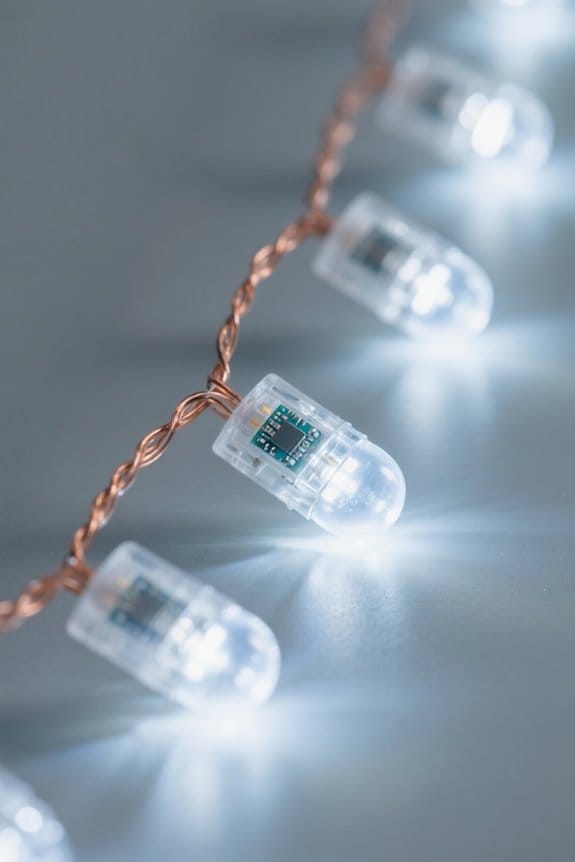
Although traditional string lights have long been popular for decorative purposes, smart string lights represent an advancement by incorporating LED technology with remote control capabilities via smartphone applications, offering precision adjustments in brightness levels often ranging from 10% to 100% and color variations across the RGB spectrum, typically supporting over 16 million shades. These smart string lights integrate seamlessly within home automation frameworks, enabling efficient management through smartphone apps that facilitate scheduling, dimming, and mode selection. Their energy-efficient LEDs consume considerably less power than incandescent counterparts, promoting reduced electricity usage. Furthermore, the inclusion of color-changing options allows users to tailor ambient lighting for diverse environments and occasions, enhancing both aesthetic appeal and functionality. Most smart outdoor lights incorporate comprehensive app control for easy management, making them a sophisticated, adaptable solution within modern home automation systems.
Connectivity Options for Smart Lighting
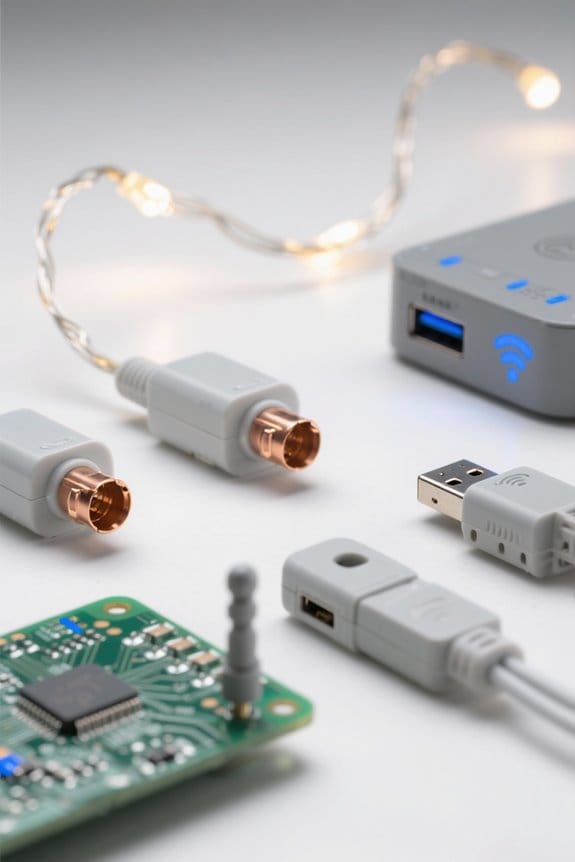
How do smart string lights connect to modern home automation systems, ensuring seamless control and integration? Connectivity options for these lights include Wi-Fi, Bluetooth, and proprietary hubs, which enable users to integrate seamlessly according to their existing smart devices and network configurations. Additionally, protocols such as Zigbee and Z-Wave enhance interoperability by allowing smart string lights to communicate with a wide array of home automation products. Control is facilitated primarily through dedicated mobile apps that offer scheduling, dynamic color changes, and scene-setting capabilities accessible from any location with internet access. These connectivity options support synchronized operation with other smart devices, enabling automated sequences tailored to various activities. Consequently, the flexibility and compatibility of these connectivity options are essential for efficient, centralized control within contemporary home automation ecosystems. IP65/IP67 ratings ensure the reliability of smart string lights in varied weather conditions, making them suitable for both indoor and outdoor use.
Integrating Smart String Lights With Voice Assistants
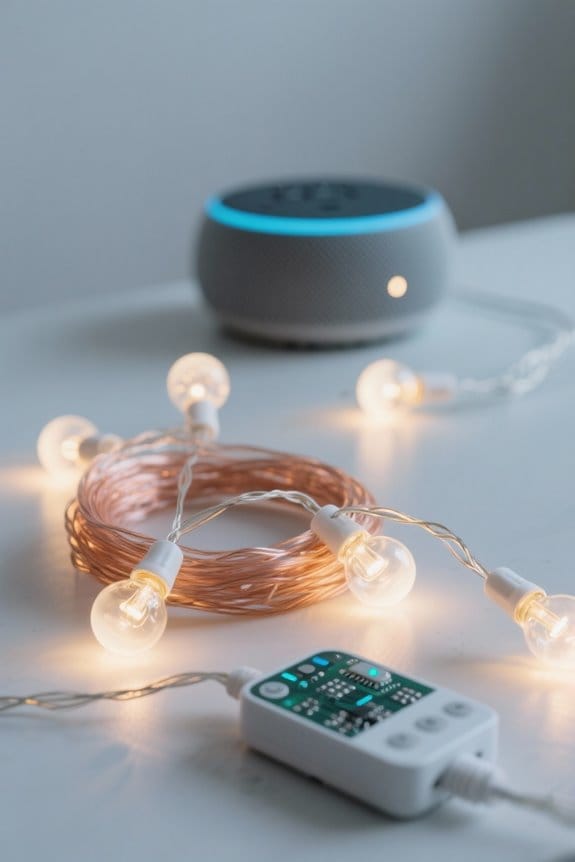
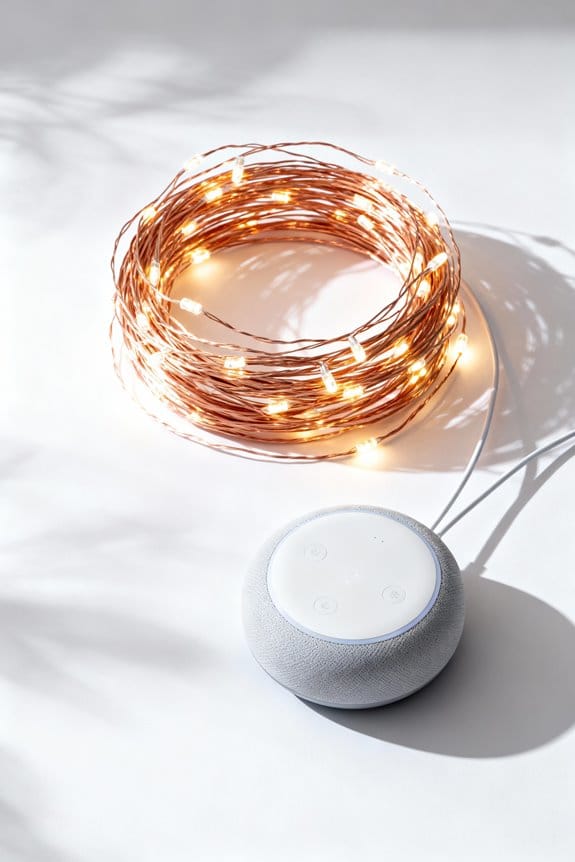
In what ways do voice assistants enhance the functionality of smart string lights within home automation environments? Voice assistants like Amazon Alexa and Google Assistant enable seamless control of smart string lights through simple voice commands, facilitating hands-free operation and improving user convenience. By linking smart string lights to compatible hubs or apps, users can integrate voice assistants to manage features such as dimming, color changing, and brightness adjustment. Additionally, voice assistants support custom routines, allowing tailored lighting settings triggered by specific commands, enhancing ambiance control. Integration with platforms like IFTTT further extends capabilities by enabling automated actions based on voice commands or other smart home events. Many smart string lights feature connectable designs for larger installations, allowing for extended control and customization through voice commands. This combination of voice assistants and smart string lights creates an interconnected system that simplifies device management and elevates the home automation experience considerably.
Scheduling and Automation Features
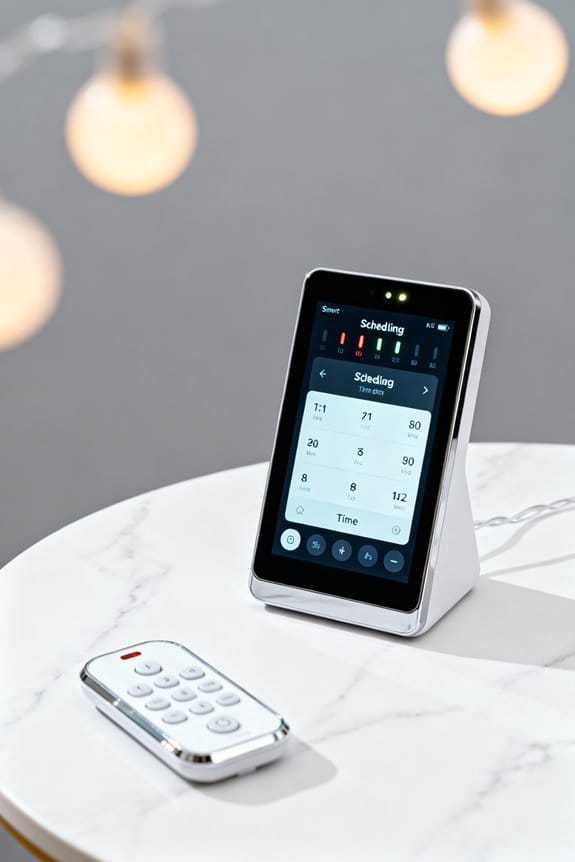
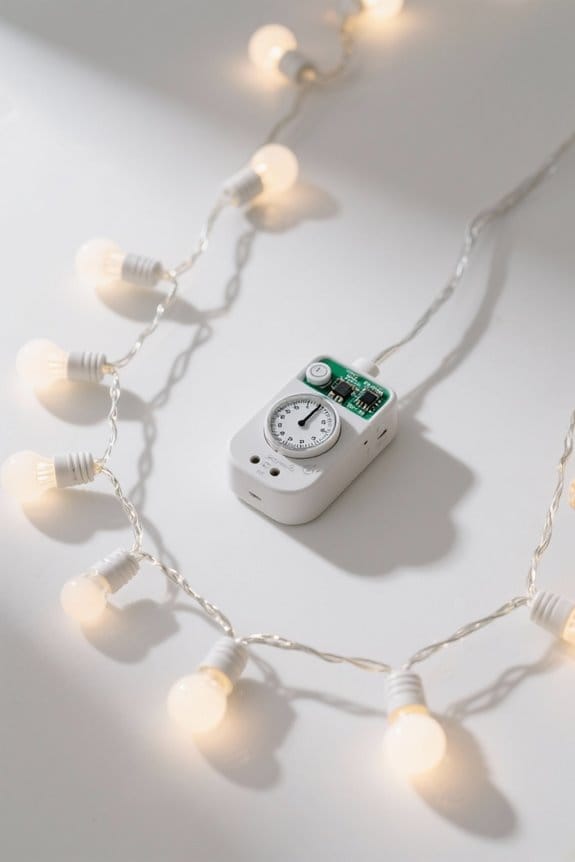
Beyond voice control capabilities, smart string lights incorporate sophisticated scheduling and automation features that greatly enhance their utility within home environments; for instance, these lights can be programmed to activate or deactivate at precise times—ranging from minute-specific intervals to predefined daily cycles—thus improving energy efficiency by minimizing unnecessary operation. Such smart lighting solutions frequently integrate motion sensors to trigger illumination based on occupancy, contributing to enhanced security and convenience. Customizable routines enable users to establish diverse schedules tailored to varying needs, including gradual dimming or preset activation during specific occasions. Additionally, these automation features often synchronize with broader home systems, allowing coordinated responses with other devices. Together, scheduling and automation optimize functional performance and user experience, demonstrating the intelligent adaptability characteristic of contemporary smart string lighting technologies. Many smart string lights, like the Brizled Smart Fairy Lights, offer music-sync capabilities that adjust lighting in real-time to audio inputs, further enhancing their dynamic functionality within home environments.
Customizing Colors and Brightness
The versatility of color and brightness customization in smart string lights represents a significant advancement in ambient lighting technology, enabling users to access a spectrum of up to 16 million hues through dedicated mobile applications, which facilitate precise adjustments tailored to specific occasions and moods. By integrating your smart lights with advanced smart lighting systems, users can modify brightness and color parameters dynamically, employing features such as tunable white options that adjust both luminance and warmth. Custom automation routines further enhance your home’s environment by enabling gradual changes and scene-based color shifts, adapted to daily cycles or events. This granular control, achieved through app interfaces or voice commands, underscores the capacity of smart string lights to deliver tailored illumination, combining technical sophistication with practical versatility for enhanced ambient experiences. Many landscape lighting kits offer features like fast-lock connectors and automation capabilities, which streamline the installation and operation process, further enhancing the user experience.
Synchronization With Other Smart Devices
Achieving ideal ambiance through smart string lights extends naturally into their ability to synchronize efficiently with other home automation devices, leveraging protocols such as Wi-Fi and Bluetooth to guarantee reliable communication and coordination. Smart string lights integrate seamlessly with major home automation systems like Philips Hue and SmartThings, allowing users to control lighting via centralized app interfaces. These lights can synchronize with motion sensors to activate automatically or adjust brightness according to ambient light levels, enhancing energy efficiency. In addition, integration with virtual assistants such as Amazon Alexa or Google Assistant enables voice-activated control lighting commands. Custom scenes that include smart string lights and additional connected devices facilitate coordinated brightness and color adjustments, creating unified atmospheres. This synchronization supports consistent performance and streamlined user experiences within extensive home automation ecosystems. For improved outdoor safety by controlling devices remotely, smart string lights can be paired with weatherproof smart plugs, providing protection against the elements while maintaining functionality.
Benefits of Using Smart String Lights in Outdoor Spaces
Although outdoor environments present challenges such as fluctuating temperatures and moisture exposure, smart string lights are engineered with weather-resistant materials including UV-stabilized PVC and IP65-rated connectors, ensuring operational integrity in conditions ranging from -20°C to 45°C and relative humidity levels up to 90 percent. These features support a robust outdoor lighting setup that remains reliable throughout seasonal changes. Additionally, smart string lights offer customizable lighting options, allowing users to adjust brightness and color to match various events and moods via smartphone controls. Their integration with home automation systems enhances convenience by enabling synchronized operation alongside security measures. The energy-efficient LED technology incorporated in these lights reduces electricity consumption compared to traditional bulbs, promoting cost savings and environmental benefits, thereby establishing smart string lights as a practical, durable, and flexible solution for outdoor illumination. With features like dimmable or multi-mode lights, smart string lights provide enhanced flexibility and elegance in outdoor settings.
Setting up Smart String Lights With Home Hubs
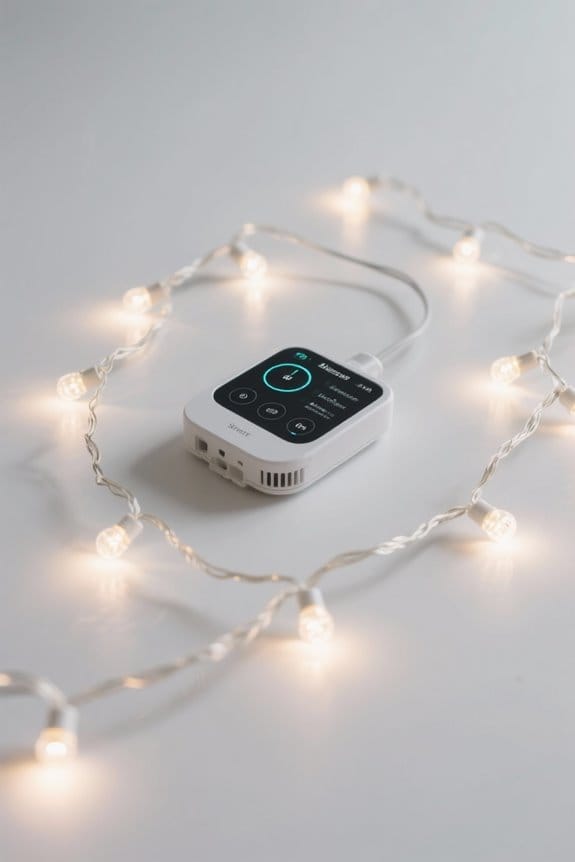
Integrating smart string lights with home hubs such as the Philips Hue Bridge or Samsung SmartThings enables centralized control, allowing users to manage multiple lighting devices through a single, unified app interface; this process typically involves connecting the lights to the hub via Wi-Fi, ensuring compatibility with a network of smart home products, and configuring advanced features like automated schedules or color-changing modes. The setup requires accessing the home hub’s app to link the smart string lights, which then become part of the broader automation ecosystem. Customization options include selecting precise color hues, adjusting brightness levels, and programming timing sequences. Additionally, voice control capabilities are activated through digital assistants like Alexa or Google Assistant, facilitating hands-free management, thereby enhancing user convenience while maintaining consistent and responsive lighting environments. Many smart string lights have a weatherproof rating of IP65 or higher, ensuring durability in various outdoor conditions.
Troubleshooting Common Integration Issues
Various obstacles frequently disrupt the seamless integration of smart string lights into home automation systems, often rooted in technical incompatibilities and network configuration errors; for instance, confirming support for communication protocols such as Zigbee, Z-Wave, or 2.4 GHz Wi-Fi is essential before installation, as unsupported devices typically fail to respond. Integration issues often arise from compatibility problems with the home automation hub, improper network settings—such as connecting to a guest network instead of the main one—and Wi-Fi connectivity challenges caused by weak signals or bandwidth limits. Addressing these problems involves verifying device compatibility, ensuring proper network settings, optimizing router placement for better Wi-Fi connectivity, updating relevant software, and performing a factory reset when necessary to restore default configurations and improve synchronization with the home automation ecosystem. Choosing weatherproof outlet covers with appropriate NEMA/IP ratings can protect smart string light connections from environmental factors, ensuring a more reliable integration with home automation systems.
Enhancing Security With Automated Outdoor Lighting
When outdoor spaces are equipped with automated lighting systems, such as smart string lights featuring motion sensors calibrated to detect movement beyond a 10-foot radius, overall security markedly improves through immediate illumination of pathways, entrances, and vulnerable zones, which studies show can reduce break-in attempts by up to 30%. These outdoor lights, integrated with home automation platforms like SmartThings or Philips Hue, enable homeowners to customize lighting schedules that mimic occupancy patterns, effectively deterring intruders during absence. Advanced systems link smart lighting activation with security cameras, triggering simultaneous recording and alert notifications upon detecting movement. This coordinated response enhances a home’s security by increasing visibility and enabling rapid incident awareness. Consequently, automated outdoor lighting represents an essential component in thorough home security strategies, balancing deterrence with real-time monitoring capabilities. Additionally, motion sensor capabilities improve security by automatically illuminating spaces, providing an extra layer of protection for homeowners.
Energy Efficiency and Cost Savings
Beyond enhancing home security, smart string lights contribute considerably to energy efficiency and cost savings by employing LED technology that reduces electricity consumption by up to 80% compared to traditional incandescent bulbs, as demonstrated in controlled laboratory tests measuring lumen output versus wattage. These energy-efficient smart string lights also feature extended lifespans of up to 25,000 hours, greatly reducing replacement frequency and associated expenses. Integration with home automation systems enables precise control through scheduling, dimming capabilities, and remote operation via mobile apps, preventing unnecessary energy usage when lights are forgotten on. Collectively, these factors optimize energy consumption patterns. Consequently, the combination of advanced LED efficiency, programmable control features, and durable design guarantees notable cost savings for homeowners, aligning with sustainable energy practices and reducing monthly electricity bills over time.
Future Trends in Smart Lighting Integration
How will smart string lights evolve within home automation landscapes over the next decade? Future trends in smart lighting integration emphasize enhanced interoperability, with protocols like Matter enabling devices from multiple manufacturers to communicate seamlessly, thereby simplifying user control through centralized home automation systems. Advances in AI will enable lights to adapt brightness and color dynamically by learning from user routines, improving personalization. Increased IoT adoption will facilitate interaction between smart string lights and other devices such as security systems and thermostats, enabling automated responses to environmental changes. In addition, energy-efficient LED technology will underpin sustainability efforts, supported by automated energy monitoring that adjusts consumption based on detected usage patterns. Collectively, these developments position smart string lights as pivotal components within more connected, efficient, and user-responsive home automation ecosystems of the future.
Frequently Asked Questions
How Do I Automate My House Lights?
Automating house lights is a game-changer that revolutionizes daily life. Through smart bulb setup, lighting schedules, motion sensors, and voice control, homeowners achieve seamless convenience and enhanced energy efficiency, transforming any space into a futuristic haven effortlessly.
What Are the Disadvantages of Smart Lights?
Smart lights face cost considerations due to higher prices, compatibility issues across brands, reliability concerns from network dependency, energy consumption variances, and security vulnerabilities that can expose users to hacking without proper protective measures in place.
Can I Control Smart Lights Remotely?
Yes, remote access to smart lights is possible via mobile apps and voice control. Installation tips enhance setup efficiency. Additionally, users benefit from energy savings by scheduling operation times, optimizing smart lighting throughout homes seamlessly.
How Iot Technology Is Implemented in Smart Lighting?
IoT connectivity enables remote monitoring and user customization of smart bulb functionality, enhancing energy efficiency. These smart lighting systems adjust settings based on user preferences and environmental data, optimizing performance while reducing power consumption through intelligent automation and control.