As an Amazon Associate, we earn from qualifying purchases. Some links on this site are affiliate links at no extra cost to you. Our recommendations are based on thorough research and editorial judgment.

Warning Signs That a Battery Might Be Damaged or Leaking

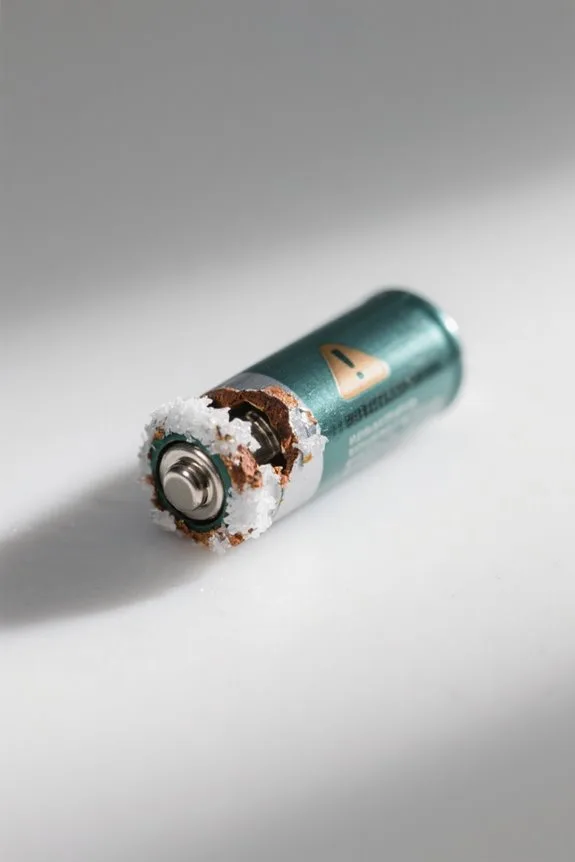
Warning signs of a damaged or leaking battery include corrosion at terminals, identifiable by white or blue-green deposits, and bulging casings caused by gas buildup that compromise structural integrity and pose acid leak risks. Electrolyte leakage often appears as clear or yellowish fluid, accompanied by a sulfuric “rotten egg” odor, while voltage readings below 12 volts under load indicate internal damage and charge instability. Dimming lights and slow engine cranking further suggest failure. Precise detection methods and safety protocols are essential for thorough assessment.
Key Takeaways
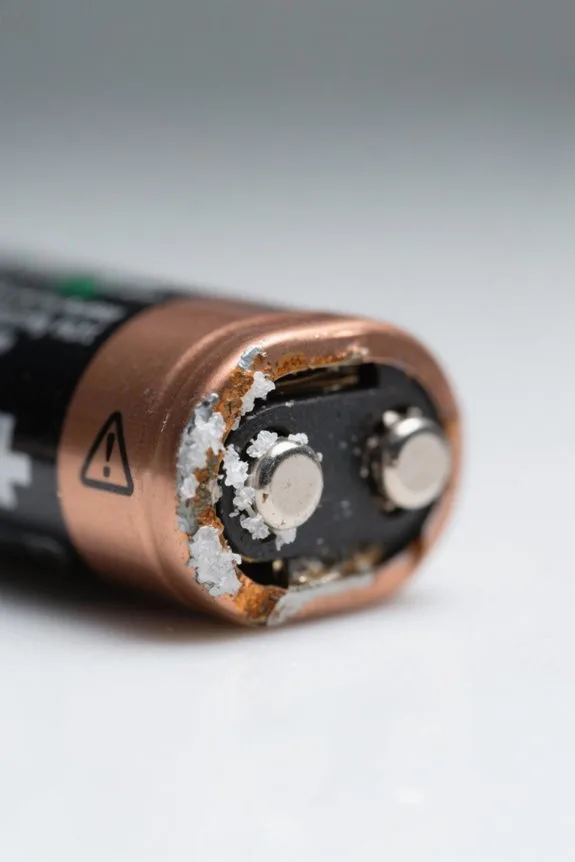
- Corrosion with a white or blue-green powdery substance around terminals indicates potential electrolyte leakage and damage.
- Bulging or swollen battery casing signals internal pressure buildup and possible hazardous acid leaks.
- Visible liquid or electrolyte leaks around the battery or terminals suggest internal damage and require prompt attention.
- Unusual rotten egg smells indicate sulfuric acid leakage or gas emissions from compromised battery cells.
- Low or rapidly fluctuating voltage readings below 12 volts under load signal internal battery damage or sulfation.
Identifying Corrosion Around Battery Terminals
Corrosion around battery terminals, typically identified by a white or blue-green powdery substance that accumulates on the metal surfaces, serves as a clear indicator of potential electrolyte leakage and compromised battery integrity; this phenomenon not only degrades the electrical conductivity essential for peak operation but also increases resistance by up to 30%, which can greatly impair the vehicle’s starting efficiency and power distribution systems. Signs of leakage manifest primarily through this powdery substance, necessitating regular inspection to prevent impaired battery performance and subsequent reduction in overall vehicle functionality. Neglecting corrosion around these terminals accelerates deterioration, often resulting in inconsistent engine starts and voltage irregularities across the electrical system. Preventative measures, including cleaning with a baking soda and water solution during periodic maintenance, are critical to sustain maximum connectivity and guarantee dependable battery operation. Using products like NOCO NCP2, which offers a universal oil-based solution, can protect against moisture and enhance connections, further preventing corrosion and improving battery life.
Recognizing Bulging or Swollen Battery Casings
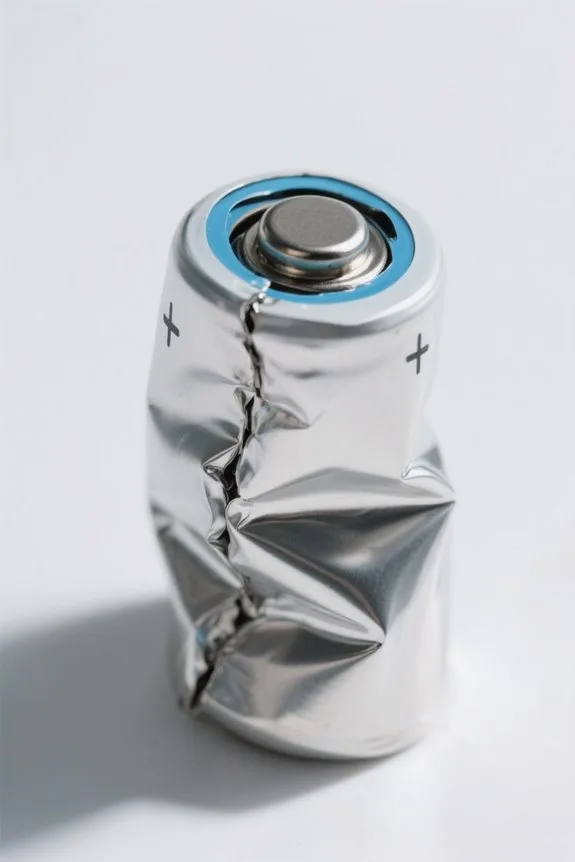
Several indicators suggest when a vehicle battery casing is bulging or swollen, a condition that frequently results from excessive internal pressure caused by overheating or gas accumulation during overcharging, with batteries typically becoming more vulnerable after three to five years of use due to natural wear and chemical degradation. A bulging battery casing presents a visible distortion in shape, making physical inspection a critical step in identifying this warning sign of damage. Such swelling compromises structural integrity and may precede a leaking battery event, releasing hazardous sulfuric acid. Due to the associated risks, including acid leaks and complete failure, prompt battery replacement is necessary when swelling is observed. Regular assessment of older batteries, combined with attention to physical deformation, guarantees timely intervention before significant safety hazards develop. As a precaution, using non-contact voltage features on multimeters can enhance operational safety by detecting voltage without direct contact, thus minimizing risks during inspection.
Recommended Products

【Top-Flight Performance 】The 51.2V 100Ah liFePO4 battery is manufactured by 16Pcs Automotive Grade A grade prismatic cells with higher energy density, more stable performance & greater power. And has a compact 5.12kWh energy, which is equivalent to 4pcs 12V 100Ah LiFePO4 batteries in 4S (or even 8pcs 12V 100Ah AGM batteries in 8S).

51.2V LiFePO4 Battery: Built with Grade A cells, this 100Ah LiFePO4 lithium battery delivers a 1C discharge rate, 55.2V float voltage, and 100A max charge/discharge current. Enjoy higher energy density than traditional lead-acid batteries

Detecting Unusual Odors and Gas Emissions
Detecting unusual odors and gas emissions can serve as a critical diagnostic tool in evaluating battery health before visible damage appears. Detecting unusual odors, such as a strong rotten egg smell signaling sulfuric acid leakage, offers an early warning sign of a leaking car battery, indicating potential internal damage. Hydrogen sulfide gas emissions, characterized by a toxic odor, often result from overcharging or compromised battery cells and should prompt immediate visual inspection for cracks or swelling. Regular battery maintenance includes consistent monitoring for such odors, as persistent detection can confirm deteriorating battery health requiring replacement. Handling batteries emitting these warning signs necessitates protective gear to prevent chemical burns and inhalation risks, emphasizing the importance of integrating odor detection with physical assessments to accurately evaluate battery condition and safety. Batteries should be disposed of through certified recycling or hazardous waste facilities to prevent environmental risks and ensure compliance with regulatory standards.
Recommended Products

FUN & FAST 3 SPEED CONTROL: Mobility Scooter,Experience the ultimate blend of comfort, style, and speed with our heavy-duty 4 wheel electric scooter. Featuring a variable speed control dial, you can effortlessly adjust your speed from 1 mph to 18 mph! Whether you're in need of mobility scooters for adults or a motorized scooter for seniors, this red elephant mobility scooter is the perfect choice for a fun, fast, and stylish ride around town.The front headlight illuminates your path, ensuring safety during nighttime rides.Featuring a storage box behind the seat, you can easily carry your personal belongings wherever you go.

Tight Turning: Engineered for the tight spaces, this pallet jack features 59.5" turning radius and a Creep Speed (Turtle) mode. This allows the pallet jack to operate with the handle in a fully vertical position, providing maneuverability and safety in narrow aisles and crowded retail floors.

FUN & FAST 3 SPEED CONTROL-Comfort, style, speed, quality, and a good price - this recreational mobility scooter has it all! Equipped with a variable speed control dial puts you in control of how fast or slow you want to go from 1 mph all the way up to 15 mph! If you have difficulty walking long distances or are simply looking for a fun, fast way to get around town, the red elephant mobility scooter will get you there in style!
Observing Liquid or Electrolyte Leakage
Frequently, observing liquid or electrolyte leakage around a battery serves as a key indicator of internal damage, particularly when clear or yellowish fluid accumulates outside the casing; transparent battery designs facilitate monitoring by revealing drops in fluid levels that fall below the manufacturer’s specified threshold of approximately 12.6 volts for fully charged 12-volt cells. Liquid leaking from the battery often manifests as a thin, visible layer on surfaces or pooling near terminals, which may also exhibit white or powdery corrosion due to electrolyte exposure. Regular examination for moisture and residue is critical in vehicles, as unnoticed electrolyte leakage can accelerate corrosion, thereby compromising the battery’s integrity and potentially impairing the vehicle’s electrical system. Timely detection of these signs allows for prompt intervention before extensive damage occurs. It is important to monitor terminals regularly for signs of wear or corrosion to maintain optimal battery performance and prevent potential issues.
Noticing Electrical System Irregularities
Electrical anomalies in a vehicle’s system often serve as early indicators of battery deterioration, manifesting through symptoms such as dimming headlights, which typically drop below the standard operating voltage of 12.6 volts for a fully charged 12-volt battery, signaling insufficient power delivery. Irregular operation of electrical components, including erratic dashboard lights and fluctuating interior illumination, may further undermine the vehicle’s performance, requiring immediate attention. These warning signs often accompany malfunctioning power windows and reduced responsiveness of multiple electronic accessories, suggesting the battery is failing to meet the electrical demand. Sudden alerts on the dashboard can also prompt a thorough battery inspection to detect corrosion or a leaking battery, preventing further damage and ensuring system stability. Early detection optimizes repair timing and vehicle reliability. It’s also important to ensure the battery holder is made of durable, high-impact plastic to prevent shorts and accidental discharge, which could further affect electrical system performance.
Addressing Vehicle Starting Difficulties
When a vehicle exhibits slow engine cranking accompanied by struggling sounds during ignition attempts, it is often indicative of a weak or compromised battery that fails to deliver adequate current, typically below the nominal 12.6 volts expected from a fully charged 12-volt battery; such conditions necessitate immediate diagnostic testing with a multimeter measuring both open-circuit voltage and load voltage under starter engagement to accurately assess battery capacity and state of health. Common signs include persistent starting difficulties, dim power accessories, and illuminated warning lights signaling electrical issues. Visible corrosion around terminals, often presenting as white or bluish powder, impairs conductivity and may suggest car battery leaking. Frequent jump starts further imply declining battery performance. Seeking professional help guarantees proper evaluation and replacement decisions to restore reliable starting function. Accurate diagnostics are crucial, especially in cold climates, where batteries are more prone to failure and need precise assessments to ensure optimal performance.
Recommended Products

【Grade A solar cells】 : The long-lasting UL61730 550W monocrystalline grade A solar cells, the waterproof design ensures that the panel can be used in all weather conditions.

⚡【Perfect 6V/8V Flooded Lead Acid Battery Replacement 】Power Queen 48V(51.2V) 100Ah Golf Cart Lithium Battery in BCI Group 8D size(dimensions of 20.47 x 10.59 x 8.66 inches) is a seamless replacement for 6V/8V flooded lead-acid batteries, ensuring effortless installation and immediate enhancement of your golfing experience,One replaces Six with a single installation - an Ultimate All-in-One Golf Cart Solution

【5120Wh, Maximize Energy】 The Redodo 25.6V 200Ah LiFePO4 battery features EV-grade cells, delivering 5120Wh and 5120W power for extended run-time, making it ideal for various household appliances.
Monitoring Battery Voltage and Charge Stability
Evaluating a vehicle’s battery requires careful observation of voltage stability and charge retention to verify its functional integrity beyond initial starting capacity. Monitoring voltage during load testing, ideally with a digital battery tester, reveals critical data about battery performance, where healthy units maintain around 12.6 volts when fully charged. Rapid voltage fluctuations or readings falling below 12 volts under load often suggest damaged internal plates or sulfation, impairing charge stability. Consistent low voltage readings after charging indicate potential internal damage or deterioration of active materials, reducing the battery’s ability to hold a charge. Such symptoms may also precede battery leaks, which further compromise safety and function. Vigilant voltage monitoring helps detect these internal issues early, ensuring prompt intervention before total battery failure occurs. Regular use of battery capacity testers ensures precise assessment and early detection of potential issues in both rechargeable and non-rechargeable batteries, enhancing long-term performance and safety.
Recommended Products

◆Micsig SigOFIT Optical-fiber Isolated Probe Unveil Real Signal You've Never Seen
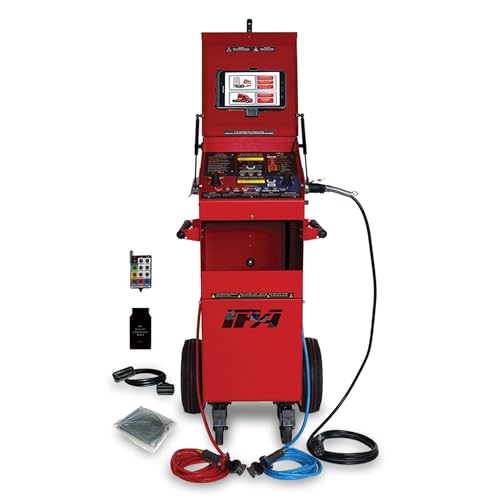
One-man testing for electrical, ABS and air brake systems
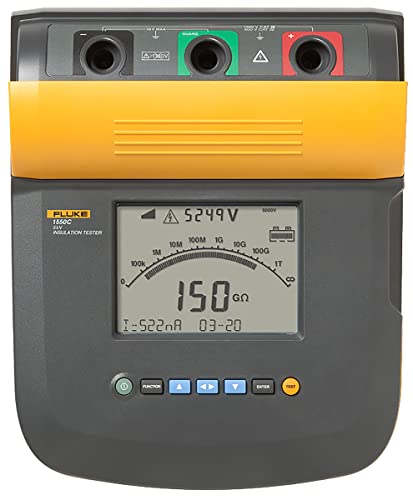
Selectable test voltages in 50 V steps from 250 to 1000 V, and 100 V steps above 1000 V
Implementing Safety Measures During Inspection
Implementing rigorous safety measures during battery inspections is critical for preventing exposure to corrosive sulfuric acid, which typically has a pH of around 0.8, and potentially harmful hydrogen gas that can accumulate in enclosed spaces, posing explosion hazards. Inspect the battery in a well-ventilated area while wearing protective gloves and goggles to shield skin and eyes from acid leaking or toxic fumes. Begin by disconnecting the battery’s negative terminal to eliminate electrical risks before closely examining signs of damage, such as cracks, bulges, or fluid residue. Avoid direct contact with any leaking substance to prevent chemical burns. If acid leaking is suspected, cease inspection and seek professional help for safe handling and disposal. Proper segregation of different battery chemistries reduces risks associated with shorting and thermal incidents. Adhering to these safety measures guarantees risk mitigation during the critical assessment of potentially compromised batteries.
Frequently Asked Questions
How Can You Tell if a Battery Is Leaking?
Leak detection involves corrosion inspection around terminals and checking electrolyte levels. Physical swelling, visual cracks, smeared residue, and terminal wear indicate damage, while battery odor signals internal issues. These signs collectively reveal a potential leaking battery.
Can I Still Drive With a Leaking Battery?
Driving with a leaking battery is unsafe due to safety concerns and potential electrical issues. Warning lights may indicate problems; maintaining regular maintenance tips and considering prompt battery replacement are essential. Emergency procedures should prioritize preventing car performance deterioration.
How Do You Know if the Battery Is Damaged?
A wilting flower symbolizes fading battery life. Through visual inspection, corrosion signs, terminal rust, swelling, low fluid levels, acid smell, and a voltage test reveal hidden damage, signaling the battery’s decline and imminent failure.
Do Car Batteries Give Warning Before Dying?
Car batteries often exhibit warning indicators before dying, including symptoms of failure like slow cranks and low voltage readings. Environmental factors and maintenance tips help extend battery lifespan, while regular testing methods reveal replacement signs efficiently.