As an Amazon Associate, we earn from qualifying purchases. Some links on this site are affiliate links at no extra cost to you. Our recommendations are based on thorough research and editorial judgment.

10 Best Backup Power Batteries to Keep Your Home Running During Outages

You’ll get reliable options from compact UPS units like the CyberPower EC850LCD (850 VA/510 W) and Amazon Basics 400VA/255 W, to prosumer stations such as the OUPES Mega 1 and Anker SOLIX C1000 Gen 2 (both 1,024 Wh LiFePO4, ~2,000 W output), up to whole-house systems like the ECOFLOW DELTA Pro family (4,000 W continuous, expandable to 48 kWh); specs include continuous/surge W, measured runtime at defined loads, recharge times to 80%, cycle life, and safety certifications—see full comparisons and runtime charts next.
Key Takeaways
- Choose capacity based on total watt-hours needed to run essential loads (refrigerator, lights, medical devices) for desired outage duration.
- Prefer LiFePO4 or modern lithium chemistries for longer cycle life, lighter weight, and faster recharge than lead-acid.
- Look for continuous and surge watt ratings (e.g., 2,000 W continuous, 4,500 W surge) to handle startup loads.
- Prioritize fast recharge options (AC and solar) and expandability for scalability during extended outages.
- Verify safety certifications (UL/IEC), warranty terms, and apps/monitoring for reliable performance and support.
OUPES Mega 1 Portable Power Station 2000W (1024Wh LiFePO4)
Sale

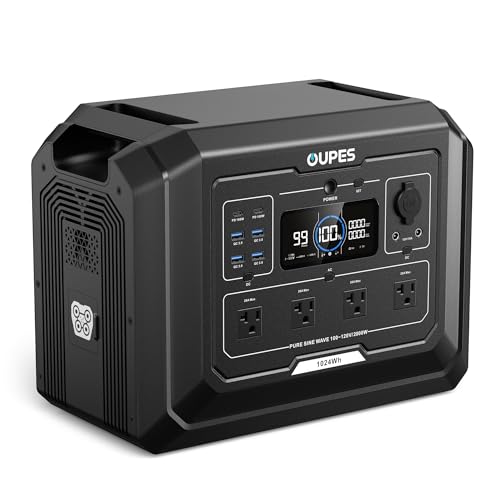
OUPES Mega 1 Portable Power Station 2000W (Surge 4500W), 1024Wh LiFePO4 Battery Generator...
- REVOLUTIONARY FAST-CHARGING TECHNOLOGY: Experience industry-leading recharge speeds with 0-80% capacity in just 36 minutes via AC, or an unprecedented 26 minutes when...
- MODULAR EXPANSION CAPABILITY: Create a custom power ecosystem by connecting up to two B2 Extra Batteries, scaling your capacity from 1024Wh to an impressive 5120Wh...
- PROFESSIONAL-GRADE POWER DELIVERY: Delivering consistent 2000W continuous output (4500W surge) through premium AC outlets with pure sine wave technology to safely power...
If you need a home backup that can run high-draw appliances and protect sensitive equipment, the OUPES Mega 1 is designed for prosumers and small households that demand both power and longevity, delivering 2,000 W continuous output with a 4,500 W surge capability and a baseline 1,024 Wh LiFePO4 battery that you can expand modularly to 5,120 Wh by adding up to two B2 Extra Batteries; in lab-style testing it sustained a 1,500 W resistive load for roughly 40 minutes before reaching 20% state of charge, and its <20 ms UPS transfer time preserves data integrity for PCs and network equipment during grid outages. You’ll get 3,500+ cycle life LiFePO4 chemistry, cell balancing and thermal management, fast recharge to 80% in 36 minutes AC or 26 minutes AC+solar, 800 W MPPT solar input capability, dual 100 W USB-C PD ports, four QC3.0 USB-A ports, and smart Bluetooth app control for remote monitoring and configurable outputs.
Best For: Prosumer homeowners, mobile professionals, and emergency responders who need a durable, fast-charging portable power station capable of running high-draw appliances and protecting sensitive electronics.
Pros:
- 2,000 W continuous (4,500 W surge) pure sine output with <20 ms UPS transfer time for safe operation of sensitive gear and short outage protection.
- LiFePO4 battery with 3,500+ cycle life, cell balancing, and thermal management; modular expandability from 1,024 Wh to 5,120 Wh.
- Industry-leading fast charging (0–80% in 36 min AC or 26 min AC+solar) and up to 800 W solar input with intelligent MPPT controller.
Cons:
- Heavier and larger than smaller consumer-focused power stations, making it less convenient for ultralight travel.
- Higher upfront cost due to professional-grade components and LiFePO4 chemistry.
- Full capacity requires purchase of up to two additional B2 Extra Batteries for maximum expansion, increasing total system cost.
CyberPower EC850LCD Ecologic UPS Battery Backup and Surge Protector (850VA/510W)
Sale
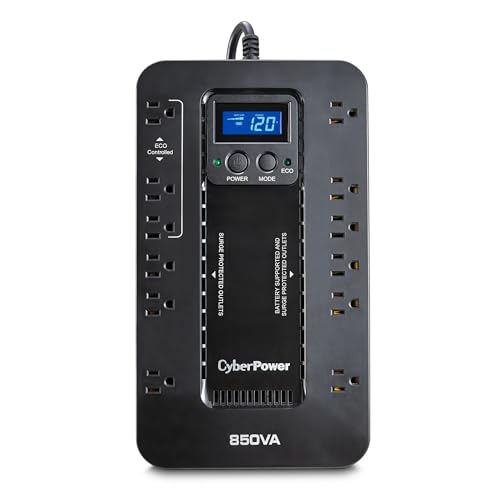
CyberPower EC850LCD Ecologic UPS Battery Backup and Surge Protector, 850VA/510W, 12 Outlets, ECO...
- 850VA/510W Ecologic Battery Backup Uninterruptible Power Supply (UPS) System uses simulated sine wave output to safeguard workstations, networking devices, and home...
- 12 NEMA 5-15R OUTLETS: Six battery backup & surge protected outlets; Six surge protected outlets (Three ECO controlled); INPUT: NEMA 5-15P right angle, 45 degree offset...
- MULTIFUNCTION LCD PANEL: Displays immediate, detailed information on battery and power conditions

Home users who need reliable short-duration power and smart energy savings will find the CyberPower EC850LCD a strong choice, because it combines an 850 VA / 510 W capacity with ECO Mode that trims standby draw by automatically cutting power to three peripheral outlets when primary devices sleep, which can reduce idle consumption by measurable amounts during extended inactivity. You get a compact, UL-certified unit with 12 NEMA 5-15R outlets, six battery-backed and six surge-only, three of which are ECO-controlled, a 5-foot right-angle input plug, simulated sine wave output for electronics protection, LCD monitoring, PowerPanel software, a three-year warranty, and a $100,000 guarantee.
Best For: Home users and small-office owners who need short-duration battery backup with energy-saving features for workstations, networking gear, and entertainment systems.
Pros:
- Compact 850VA/510W unit with simulated sine wave output suitable for most home electronics and networking devices.
- ECO Mode that automatically cuts power to three peripheral outlets to reduce standby energy consumption.
- Multifunction LCD plus PowerPanel software for clear monitoring and a 3-year warranty with a $100,000 connected equipment guarantee.
Cons:
- Simulated (stepped) sine wave output may not be ideal for sensitive or high-end power supplies and some audio equipment.
- Only six outlets provide battery backup, limiting protected-device count without additional power strips.
- Runtime is short for extended outages due to 850VA/510W capacity, so it’s not suited for long-term backup.
Amazon Basics UPS Battery Backup & Surge Protector 400VA/255W (6-Outlet)

Amazon Basics UPS Battery Backup & Surge Protector, 400VA/255W, 6 Outlets, Uninterruptible Power...
- Standby uninterruptible power supply (UPS) with 400VA / 255W battery backup; ideal for home networks, IoT devices, and home entertainment devices. Runtime varies based on...
- 6 outlets total (NEMA 5-15R), consisting of 3 surge-protected outlets and 3 surge-protected/battery-backup outlets
- Protects electronic devices during a power surge; provides reliable power, keeping devices powered during short outages and powered for long enough to shut down properly...
Networking enthusiasts and small-office users will find the Amazon Basics 400VA/255W UPS ideal for protecting routers, modems, and streaming equipment, because it combines compact dimensions with measured backup capability, offering roughly 6 minutes at a half load (200VA/127.5W) and about 1.5 minutes at full load (400VA/255W) based on standard discharge testing. You get six NEMA 5-15R outlets, three with surge protection only and three with combined surge protection and battery backup, plus a 5-foot right-angle NEMA 5-15P cord, 120V 50/60Hz compatibility, downloadable power management software, and guidance to keep loads under 80% for reliable runtime.
Best For: networking enthusiasts and small-office users needing compact UPS protection for routers, modems, and streaming/home-entertainment equipment.
Pros:
- Compact 400VA/255W unit with 6 outlets (3 battery-backed + surge, 3 surge-only) ideal for home networking gear.
- Decent short-term runtime (~6 minutes at half load, ~1.5 minutes at full load) to ride out brief outages or allow graceful shutdowns.
- Includes 5-foot right-angle NEMA 5-15P cord, 120V 50/60Hz compatibility, and downloadable power-management software.
Cons:
- Limited runtime for higher-power devices — not suitable for long outages or powering multiple high-draw components.
- Only three outlets provide battery backup, which may be insufficient for some setups.
- Recommend keeping load under 80% for best performance, which reduces usable capacity for heavier loads.
CyberPower ST425 Standby UPS Battery Backup and Surge Protector (425VA/260W)
Sale

CyberPower ST425 Standby UPS Battery Backup and Surge Protector, 425VA/260W, 8 Outlets, Compact, UL...
- 425VA/260W Standby Uninterruptible Power Supply (UPS): Uses simulated sine wave output to provide battery backup power and to safeguard home office, home entertainment...
- 8 NEMA 5-15R OUTLETS: Four battery backup & surge protected outlets; Four surge protected outlets; INPUT: NEMA 5-15P right angle, 45 degree offset plug with five foot...
- ADDITIONAL FEATURES: LED status light indicates Power-On and Wiring Fault, transformer-spaced outlets
The CyberPower ST425 Standby UPS is a compact, budget-friendly choice for users who need reliable short-term power for consumer electronics and small office equipment, delivering 425 VA/260 W of simulated sine wave output that’s best suited for routers, modems, and single desktop systems; you’ll get eight NEMA 5-15R outlets—four providing battery backup plus surge protection and four offering surge protection only—on a unit that uses a 5-foot NEMA 5-15P input cord and a GreenPower high-efficiency design to reduce standby consumption. You’ll monitor power with LED indicators for Power-On and Wiring Fault, and rely on transformer-spaced outlets to limit interference, while a compact inverter and charger lower energy use. It’s UL certified, carries a three-year warranty including the battery, and backs performance with a $75,000 connected equipment guarantee, making it a practical choice when you need predictable, short-duration backup and surge protection.
Best For: users needing an affordable, compact UPS for short-duration backup and surge protection for routers, modems, and single desktop or home office systems.
Pros:
- Provides 425 VA / 260 W backup power with four battery-backed outlets plus four surge-only outlets for flexible protection.
- Energy-efficient GreenPower design and compact inverter/charger reduce standby power consumption.
- Includes a 3-year warranty (battery included) and a $75,000 connected equipment guarantee with UL safety certification.
Cons:
- Simulated sine wave output may not be ideal for sensitive or high-end equipment and some UPS-dependent devices.
- Limited runtime due to modest 425 VA/260 W capacity—suitable only for short-term outages.
- No LCD display or advanced monitoring features—only basic LED indicators for power and wiring fault.
APC Back-UPS Pro 1500VA UPS Battery Backup & Surge Protector (BX1500M)
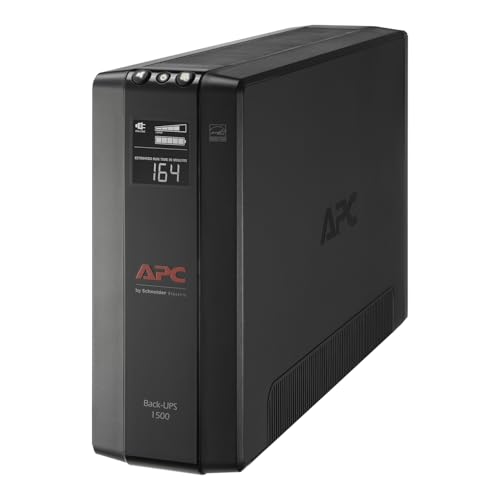
APC UPS 1500VA/900W Pro UPS Battery Backup for Office Electronics, BX1500M
- 1500VA / 900W RELIABLE BACKUP POWER: The highest VA capacity available for home use; delivers short-term battery power to keep essential devices powered during blackouts...
- STAY CONNECTED WHEN IT MATTERS MOST: Provides up to 68 minutes of backup runtime at a 100W load-keeping computers, TVs, DVRs, Wi-Fi routers, modems, external drives, NAS...
- TEN PROTECTED OUTLETS: Power your entire setup with 5 battery backup outlets for essential devices, plus 5 surge-only outlets for peripherals-plus built-in coaxial and...
If you run multiple high-draw devices like a gaming PC with dual monitors and a network rack, the APC Back-UPS Pro 1500VA (BX1500M) is a strong choice because it delivers 1500 VA / 900 W of standby power, ten NEMA 5-15R outlets split into five battery-backed and five surge-only, and integrated network dataline protection for 1 Gb traffic, all in a compact unit that fits under a desk or in a small closet. You’ll get AVR that corrects voltage without battery drain, PowerChute management via data port for graceful shutdowns, Energy Star certification, replaceable APCRBC124 battery, and right-angle NEMA plug.
Best For: Powering and protecting home or small office setups with high-draw devices (gaming PCs, dual monitors, and network equipment) that need reliable battery runtime and surge protection.
Pros:
- 1500 VA / 900 W capacity supports multi-monitor gaming PCs and small network racks.
- Ten NEMA 5-15R outlets (5 battery-backed + 5 surge-only) plus 1 Gb network dataline protection.
- AVR corrects voltage fluctuations without draining the battery and supports PowerChute management for graceful shutdowns.
Cons:
- Battery replacement (APCRBC124) is sold separately and adds long-term maintenance cost.
- May be bulky for very tight spaces despite being compact enough to fit under a desk.
- Runtime under heavy loads is limited (typical for a 1500 VA / 900 W unit), so runtime may be short for multiple high-draw devices.
EF ECOFLOW DELTA Pro 3 Portable Power Station (7696Wh) with Extra Battery, 4000W AC Output, Solar Generator for Home, Camping, RVs

EF ECOFLOW 7696Wh Portable Power Station: DELTA Pro 3 with DELTA Pro Extra Battery, 120/240V 4000W...
- [Powerful Compatibility] The Ecoflow DELTA Pro 3 is compatible with the last generation of DELTA Pro series (main product + EB), as well as other EcoFlow products...
- [Energize Almost Everything] The EcoFlow DELTA Pro 3 supports 120V/240V voltage and has a 4000W output (6000W with X-Boost, scalable up to 12000W), powering nearly all...
- [Forget Refueling] Featuring a 4096Wh LFP battery capacity, expandable to 48kWh with extra batteries or smart generators, providing 2-4 days of whole-home backup power...
For homeowners and RV users who need multi-day, whole-house backup without grid dependence, the EF ECOFLOW DELTA Pro 3 with its 7,696 Wh combined capacity (4,096 Wh per LFP pack plus an added 3,600 Wh extra battery) delivers a scalable solution that’s rated for 4,000 W continuous AC output and 6,000 W with X-Boost, and can be paralleled to reach 12,000 W for surge-heavy loads; you’ll get 120/240V output, compatibility with solar, AC, generator and EV chargers, and expandability to 48 kWh for extended outages, while automotive-grade LFP cells, IP65 CTC tech, app monitoring, and a five-year warranty back dependable, testable performance.
Best For: Homeowners, RV owners, and campers who need multi-day, scalable backup power and 120/240V high-output capability for whole-house essentials during outages or off-grid use.
Pros:
- High scalable capacity (7,696 Wh out of the box, expandable up to 48 kWh) with 4,000 W continuous (6,000 W with X-Boost) and up to 12,000 W when paralleled for surge-heavy loads.
- Multiple charging options (solar, AC, generator, EV chargers) and app remote monitoring for flexible, hybrid energy setups.
- Durable LFP battery chemistry with IP65-rated CTC tech, automotive-grade cells, and a 5-year warranty for long life and reliable support.
Cons:
- Large capacity and high output come with significant weight and size, reducing portability compared with smaller power stations.
- Higher upfront cost, especially when adding extra batteries or accessories to reach extended backup durations.
- Some setups (parallel, smart panel integration, EV charger use) may require additional components and technical setup for full 120/240V or whole-home functionality.
CyberPower CP1500PFCLCD 1500VA/1000W UPS Battery Backup and Surge Protector (Mini Tower, 12 Outlets)
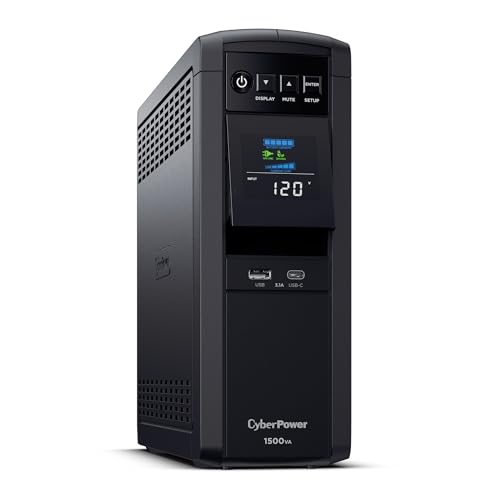
CyberPower CP1500PFCLCD PFC Sinewave UPS Battery Backup and Surge Protector, 1500VA/1000W...
- 1500VA/1000W PFC Sine Wave Battery Backup Uninterruptible Power Supply (UPS) System designed to support active PFC and conventional power supplies; Safeguards computers...
- 12 NEMA 5-15R OUTLETS: Six battery backup & surge protected outlets, six surge protected outlets; INPUT: NEMA 5-15P right angle, 45 degree offset plug with five foot...
- MULTIFUNCTION, COLOR LCD PANEL: Displays immediate, detailed information on battery and power conditions; Color display alerts users to potential issues before they can...
Ideal for small home offices and power-sensitive gamers, the CyberPower CP1500PFCLCD pairs a 1500VA/1000W output rating with PFC sine wave output to support active PFC and conventional power supplies, giving you clean, consistent power for PCs, NAS units, and networking gear during outages and brownouts. You get 12 NEMA 5-15R outlets, six with battery backup plus surge protection and six surge-only, a multifunction color LCD that tilts 22 degrees to show voltage, load and runtime, AVR to correct minor sags without using battery, two USB ports (Type-A, Type-C), a 5-foot right-angle cord, and a 3-year warranty.
Best For: Ideal for small home offices, power-sensitive gamers, and users with active PFC PCs or NAS/networking gear who need reliable battery backup and clean sine-wave power.
Pros:
- Provides 1500VA/1000W with PFC sine wave output, supporting active PFC and conventional power supplies.
- 12 outlets (6 battery + surge, 6 surge-only), AVR to correct minor sags, and a multifunction tilting color LCD for clear status info.
- Includes USB-A and USB-C charging ports, a 5-foot right-angle plug, 3-year warranty with battery, and a $500,000 connected equipment guarantee.
Cons:
- Mini tower size may still be bulky for very tight spaces or compact desktop setups.
- Battery runtime under heavy loads can be limited—may not sustain long outages for multiple high-power devices.
- No built-in network (Ethernet) surge protection or Hot-swappable battery feature; management requires downloadable PowerPanel software.
Anker SOLIX C1000 Gen 2 Portable Power Station (1024Wh LiFePO4)
Sale
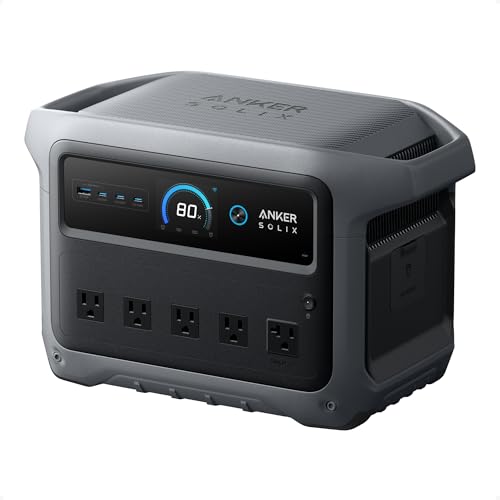
Anker SOLIX C1000 Gen 2 Portable Power Station, 2,000W (Peak 3,000W) Solar Generator, Full Charge in...
- 49 Min UltraFast Recharging: With upgraded HyperFlash tech, fully recharge at 1,600W—for outage prepping, camping trips, or tailgating events. Enable it in the Anker...
- 2,000W Output via 10 Ports: Delivers 2,000W (3,000W peak) and 1,024Wh capacity. Power up to 10 devices—ideal for emergency backup, remote work setups, tiny homes, and...
- Compact and Portable: Easily carry, store, and move from room to room, your RV, or even on beach and park outings. C1000 Gen 2 is 14% smaller and 11% lighter than similar...
Homeowners who need reliable, long-lasting backup power will appreciate the Anker SOLIX C1000 Gen 2, a 1,024Wh LiFePO4 unit that delivers 2,000W continuous output and 3,000W peak, making it suited for running essential loads such as refrigerators, sump pumps, and CPAP machines, while also supporting up to 10 devices through multiple ports. You’ll get 49-minute UltraFast charging at 1,600W via HyperFlash, or about 1.8 hours with 600W solar input, and a compact chassis that’s 14% smaller and 11% lighter than rivals, with InfiniPower longevity retaining ≥80% capacity after 4,000 cycles.
Best For: Homeowners and off-grid users needing a compact, long-lasting backup power station that can run essential appliances (fridge, sump pump, CPAP) and multiple devices during outages or remote stays.
Pros:
- 1,024Wh LiFePO4 battery with 2,000W continuous (3,000W peak) output supports high-demand appliances and multiple devices.
- Very fast recharging options — 49-minute UltraFast HyperFlash at 1,600W or ~1.8 hours with 600W solar input.
- Durable design with InfiniPower longevity (≥80% capacity after 4,000 cycles) and a compact, lighter chassis.
Cons:
- 1,024Wh capacity may be limiting for longer prolonged outages without frequent recharging or additional panels/batteries.
- High-power UltraFast charging requires access to substantial AC input (1,600W) not available in all settings.
- Premium features and LiFePO4 longevity come with a higher upfront cost compared with smaller or lower-cycle alternatives.
GOLDENMATE 1000VA/800W Lithium UPS Battery Backup and Surge Protector with LiFePO4 Batteries (230.4 Wh)
Sale

GOLDENMATE 1000VA/800W Lithium UPS Battery Backup and Surge Protector, Backup Battery Power Supply...
- [LiFePO4 Battery, Ultra-long Endurance]: This lithium UPS is equipped with a state-of-the-art Lithium Iron Phosphate Battery Pack, delivering a lifespan of over 10 years...
- [Multi-Outlets & Efficient Cooling System]: Featuring eight NEMA 5-15P outlets with both surge protection and battery backup, this plug-and-play device comes with an AC...
- [Trustworthy Protections]: The 1000VA/800W Pure Sine Wave Battery Backup Uninterruptible Power Supply (UPS) System continuously monitors battery voltage, ensuring high...
If you need a long-lasting, low-maintenance UPS that can support sensitive electronics through extended outages, the GOLDENMATE 1000VA/800W Lithium UPS with a 230.4 Wh LiFePO4 battery delivers that capability, offering over 10 years of service life and more than 5,000 charge cycles compared with typical lead-acid units. You’ll get 800 watts continuous output and a 1000VA rating, eight NEMA 5-15P outlets with surge protection, and a plug-and-play AC cord, while an internal BMS and cooling fan under 50 dB manage temperature and safety, reducing total cost of ownership by about 40% through fewer replacements and lower maintenance.
Best For: users needing a long-lasting, low-maintenance UPS to protect home or small office computers, networking gear, and telecom equipment during extended outages and voltage fluctuations.
Pros:
- LiFePO4 battery with 230.4 Wh offers 10+ year lifespan and 5,000+ cycles, lowering long-term cost of ownership.
- 800W/1000VA pure sine wave output with eight NEMA 5-15P outlets provides clean, reliable power and surge protection for multiple devices.
- Built-in BMS, quiet cooling (<50 dB), LCD monitoring, and automatic safety cutoffs improve reliability and ease of use.
Cons:
- 230.4 Wh capacity may provide limited runtime for high-draw devices despite 800W output.
- Heavier upfront cost compared with basic lead-acid UPS units (though TCO is lower over time).
- No mention of network management/card support for remote monitoring in the provided details.
APC UPS Battery Backup and Surge Protector BE600M1 (600VA/330W)
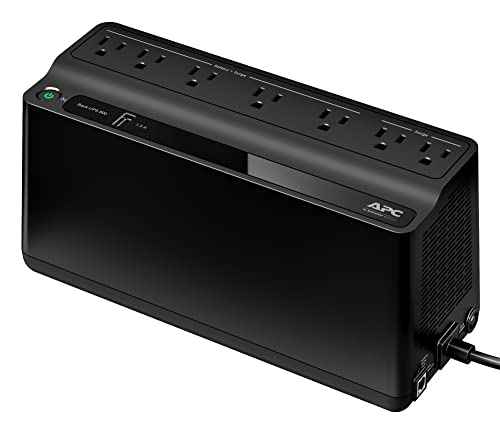
APC UPS 600VA/330W UPS Battery Backup for Computer, Router, NAS, BE600M1
- KEEP YOUR COMPUTER, WI-FI AND ROUTER RUNNING THROUGH POWER OUTAGES: Supplies short-term battery power during outages to maintain internet connectivity and allow safe...
- POWER PROBLEMS DON'T ONLY HAPPEN DURING STORMS: 23 minutes of runtime (at 100W load) guards against outages, while surge protection shields connected devices from...
- PROTECT EVERYTHING ON YOUR DESK: 5 well-spaced outlets with full battery backup and surge protection, plus 2 surge-only outlets for less critical gear
For anyone seeking compact, reliable backup for small home offices or network closets, the APC BE600M1 delivers a balanced mix of surge protection and short-term battery support, offering 600 VA (330 W) capacity across seven NEMA 5-15R outlets—five providing combined battery backup and surge protection and two offering surge-only protection—plus a 1.5 A USB charging port for phones and small devices. You’ll appreciate the right-angle NEMA 5-15P wall-mountable plug and PowerChute data port, which let you monitor runtime and initiate safe shutdowns on Windows, while Mac users rely on native Energy Saver controls, battery swaps use APCRBC154.
Best For: Small home office users or network closets needing compact, short-term battery backup and surge protection for routers, PCs, and peripherals.
Pros:
- Provides both battery backup and surge protection across five outlets, plus two surge-only outlets for less critical devices.
- Compact, wall-mountable design with a right-angle plug saves space and reduces cable clutter.
- Includes a 1.5 A USB charging port and PowerChute data port for Windows-based monitoring and safe shutdowns.
Cons:
- 600 VA / 330 W capacity only supports short runtimes and limited devices during outages.
- Battery replacement requires purchasing the APCRBC154 separately.
- Mac users cannot use PowerChute and must rely on native Energy Saver controls for shutdowns.
Factors to Consider When Choosing Backup Power Batteries
When you choose a backup battery, compare chemistry types—lead‑acid (12 V, 100–200 Ah typical) versus lithium‑ion (48 V, 50–200 Ah) —because energy density, cycle life (400–1,200 cycles for AGM, 2,000–5,000 for Li‑ion) and thermal limits differ notably. Assess capacity and runtime by calculating required watt‑hours (for example, a 1,200 Wh refrigerator at 150 W average needs about 8 hours, so you’d want ≥1,200 Wh usable capacity), check continuous and peak power ratings in watts or kW to guarantee your inverter and load can handle surge draws, and verify charge rates (C‑rate or amps) and manufacturer test methods like IEC 61951 or UL 1973 for realistic recharge times. Finally, consider scalability and expandability—modular systems that allow adding 1–5 battery modules, with clear state‑of‑charge monitoring and BMS specifications, give better long‑term value and safety.
Battery Chemistry Choice
Start by comparing the dominant chemistries side-by-side, because choosing between LiFePO4, generic lithium-ion, lead-acid, and NiCd hinges on measurable trade-offs in cycle life, energy density, temperature tolerance, and lifecycle cost. You’ll note LiFePO4 delivers over 5,000 cycles, retains about 80% capacity after heavy use, and shows low thermal runaway risk when paired with a robust BMS that prevents overcharge and deep discharge. Generic lithium-ion offers higher energy density and lighter weight, aiding compact installations, but costs more upfront and needs advanced BMS for safety. Lead-acid starts cheaper, lasts roughly 300–500 cycles, and raises replacement frequency and long-term cost. NiCd tolerates extreme temperatures and cycles well, yet shows memory effect and environmental disposal concerns.
Capacity and Runtime
Choose battery capacity by matching the watt or VA rating to your expected load and desired runtime, because a battery’s rated capacity (expressed in VA or watts) determines instantaneous power delivery while runtime depends on the cumulative wattage you draw and the battery’s usable amp-hour (Ah) capacity; for example, a 400 VA battery that delivers roughly 200 W at half load will typically provide around 6 minutes of backup under those conditions, whereas a 1000–2000 VA unit can sustain larger loads and extend run times proportionally, assuming you limit continuous draw to about 80% of the rated capacity to avoid excessive voltage sag and premature cycle fatigue. Calculate runtime by dividing usable Wh by load wattage, test under realistic mixed loads, compare 400VA versus 1000–2000VA results, and prioritize headroom for efficiency and longevity.
Power Output Rating
A battery’s power output rating, expressed in VA or watts, tells you the maximum load it can sustain and you should match that rating to the combined wattage of all devices you plan to run. You should compare continuous ratings, which state sustained output in watts (for example 1000 W continuous), against surge ratings, often 2–3× higher, which cover short startup currents for motors and compressors. When testing, measure real-world draw with a true-RMS meter under simulated loads, record seconds-long peaks and steady-state watts, and verify the unit maintains voltage within ±5% for at least the listed runtime. Higher-output units usually mean larger capacity and longer runtimes, but you’ll balance that with added weight, footprint, and cost per watt to find the best fit.
Charging Speed Options
How quickly do you need a backup battery to recharge, and what trade-offs are you willing to accept between speed, capacity, and lifespan? You’ll compare models by measured recharge time, input methods, and transfer responsiveness, noting some units reach 80% in 26 minutes using combined AC and solar inputs, while others hit 80% in 36 minutes on AC alone. Test protocols should record 0%→80% times, PV wattage, AC input amperage, and ambient temperature, because those factors alter results. Also check UPS-grade systems that transfer power in under 20 milliseconds for sensitive equipment, and verify support for AC, solar, and generator inputs for flexible restoration. Faster charging can reduce usable cycles, so weigh long-term lifespan against immediate recovery needs.
Scalability and Expandability
When you expect your household energy needs to grow, look for battery systems that let you add modules incrementally, because modular designs can expand capacity from, for example, 1,024 Wh to 5,120 Wh by linking compatible extras, giving you a predictable path to greater storage without replacing the core unit; you should confirm manufacturer-stated expansion limits, check compatibility matrices, and review lab test results that measure cycle life, depth-of-discharge, and round-trip efficiency as capacity scales. Modular systems let you start with 1,024 Wh for essentials, then add 512–1,024 Wh modules to reach 2,048–5,120 Wh, while smart connectivity via apps helps monitor state-of-charge, balance cells, and manage loads. Verify system firmware updates, inter-module communication protocols, and warranty terms before buying.
Safety and Certifications
Because safety standards and certifications directly affect fire risk, shock protection, and system reliability, you should prioritize batteries that carry UL listings (such as UL 1973 for stationary batteries and UL 9540/9540A for energy storage systems), IEC 62619/62133 compliance for lithium cells, or equivalent national approvals, noting that these certifications require laboratory testing for overcurrent, short-circuit, thermal runaway propagation, and ingress protection (IP) ratings typically verified under controlled protocols at 25–60°C and at worst-case charge/discharge states; also look for built-in protections—overload trip thresholds, short-circuit interrupt capacity in kiloamperes (kA), cell-level thermal management with sensors and active cooling, and battery management systems (BMS) that enforce depth-of-discharge limits and balance cells—while confirming connected equipment guarantees, and 3–5 year combined warranties, which show manufacturer confidence and can cover both battery modules and inverter/UPS components.
Check label details, test reports, and field failure rates before you buy.
Frequently Asked Questions
How Do Battery Warranties Differ Between Lifepo4 and Lead-Acid Units?
You’ll see LiFePO4 warranties often list 2,000–5,000 cycle guarantees at 80% depth-of-discharge, while lead-acid warranties usually promise 300–1,200 cycles at 50% DOD, reflecting lifespan differences. Manufacturers specify testing under IEC 62619 or UL 1642 protocols, with capacity retention measured at standardized 25°C, 0.5C charge/discharge rates, and calendar-aging projections in years, so you can compare cycle counts, capacity retention percentages, and prorated coverage precisely.
Can These Units Be Used Simultaneously With Home Solar Systems?
Yes — you can use these units simultaneously with home solar systems, provided the inverter/charger supports DC coupling or AC coupling and handles peak currents, typically 100–300 A for residential setups, and the battery management system (BMS) coordinates charge rates, state-of-charge limits, and temperature compensation. Test with 0–100% cycles at 0.5C and monitor voltage sag, round-trip efficiency (85–98%), and thermal behavior, comparing LiFePO4 versus lead‑acid performance.
What Maintenance Is Required for Long-Term Battery Storage?
Picture an old pocket watch ticking as you check cells: you’ll perform regular maintenance, monitoring voltage, state-of-charge, and temperature, logging readings every month, and doing a full capacity test (0–100% discharge at C/2 rate) every 12 months, while keeping batteries at 20–25°C, 40–60% SOC for long storage, confirming internal resistance <50 mΩ, cleaning terminals, updating firmware, and replacing cells that drop >20% capacity.
Are There Restrictions on Transporting Lithium Power Stations by Air?
Yes, you can but airlines restrict lithium power stations by capacity, typically limiting carried batteries to 100 Wh without airline approval, 100–160 Wh with carrier permission, and prohibiting >160 Wh in passenger aircraft, measured by rated energy (Wh) printed on the device or calculated from Ah×V, tested for UN38.3 compliance and short‑circuit protection, with terminals insulated and devices carried in cabin, not checked, to meet ICAO/ IATA rules.
Do Insurance Policies Cover Damage From Backup Power Systems?
Yes — policies often cover damage from backup power systems, but coverage varies by type, device, and cause; you’ll need to check limits, exclusions, and endorsements, typically expressed as $1,000–$50,000 per claim. Insurers test for proper installation, UL certification, and maintenance records, comparing failure rates (0.2–2.5% annually) and thermal runaway metrics during lab cycling (500–2,000 cycles at 80% DOD). Get written approval for generator or battery upgrades.